Four-Barred Swordtail

Four-Barred Swordtail

Protographium leosthenes

Daily sighting probability ~10% · With luck
at Lamington National Park

In 3 days ~20% in a week ~40%

7 Verified sightings at Lamington National Park From 2019 to 2026
7 In 1 park
February Best month
☀️ Diurnal When it's spotted

About the Four-Barred Swordtail

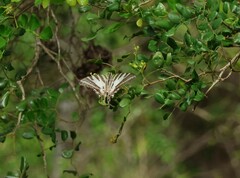
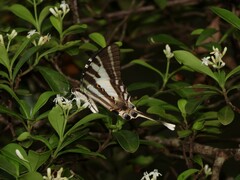
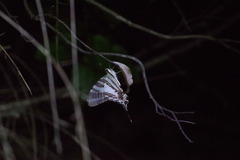
Protographium leosthenes, the four-barred swordtail, is a medium-sized butterfly of the family Papilionidae found in Australia. It is similar to the five-barred (or chain) swordtail (Graphium aristeus) found in both Australia and India.

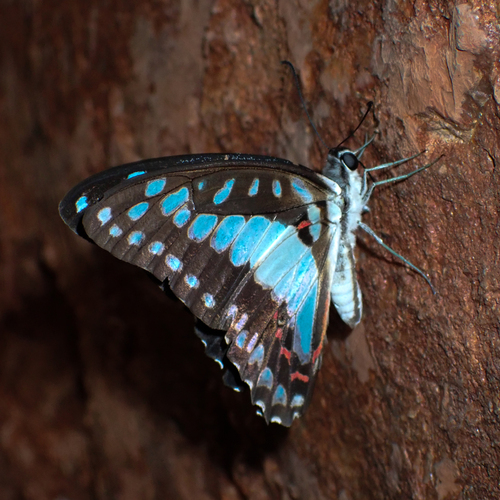
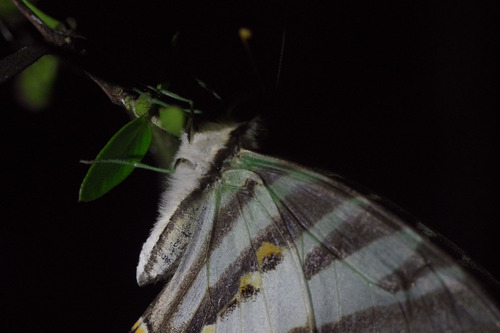
Adults are brown and white, with four brown parallel bars running down the leading edge of the forewing. The hindwings have a pointed tail. Their wingspan is approximately 49 mm for males and 53 mm for females. The four-barred swordtail can be distinguished from the five-barred swordtail by the number of bars, and pale orange and blue spots on the upperside of the hindwing. In addition, the four-barred swordtail has pale orange markings on the underside of its hindwing, rather than red markings.

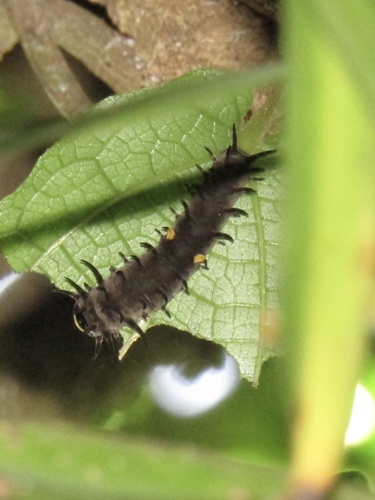
The eggs are cream coloured and laid singly on young leaves of the larval plant. The larvae feed on Melodorum leichhardtii, Melodorum rupestre, Polyalthia nitidissima and occasionally Desmos wardianus. Early instars are pale green, with black spots and a black thorax and tail. The caterpillar later becomes green with brown or yellow spots, and reaches a length of up to 3.5 centimetres. The pupa is about 2 centimetres in length,... Wikipedia →
Global Distribution

Parks Where Found

# Park Country Daily sighting probability
1 Lamington National Park 🇦🇺 Australia
~10%

More parks will be added in future updates.

Before you go

What are the chances of seeing a Four-Barred Swordtail in Lamington National Park?

With luck

About 10% of wildlife watchers report a Four-Barred Swordtail sighting in Lamington National Park on a given day, based on 7 verified sightings from GBIF citizen-science data from 2019 to 2026. It is the 263rd most-seen of the 430 insects we can rate there. Over three days the chance rises to about 20%, and over a week to about 40%, if each day is a fresh chance.

When is the best time to see a Four-Barred Swordtail in Lamington National Park?

February and March

In those months about 20% of wildlife watchers report a Four-Barred Swordtail in Lamington National Park on a given day, against under 5% in April to November, the lowest months. Those are among Lamington National Park's wettest months, with about 160 mm of rain a month against 40 mm in August.

What time of day is best to see a Four-Barred Swordtail?

Between 10 am and 1 pm

Across all the parks we cover, that three-hour window holds the most Four-Barred Swordtail sightings with a recorded time, and nearly all of them come between 6 am and 6 pm: it is a daytime animal.

Where else can you see a Four-Barred Swordtail?

Only Lamington National Park, in our data

Lamington National Park is the only park on Wallace's Line with enough records to rate Four-Barred Swordtail sightings: about 10% of wildlife watchers there report one on a given day.

Which relatives of the Four-Barred Swordtail live in Lamington National Park?

Same family: Papilionidae

The closest relatives of the Four-Barred Swordtail that you can see in Lamington National Park (family Papilionidae, Swallowtails and Parnassians) are Orchard Swallowtail (about 30%), Richmond Birdwing (about 30%) and Macleay's Swallowtail (about 20%), with each one's daily chance of a sighting.

Where does the Four-Barred Swordtail sighting chance come from?

GBIF citizen-science records

It is estimated from how often the Four-Barred Swordtail is recorded against all the insects logged in Lamington National Park (7 verified sightings from 2019 to 2026), calibrated against known sighting rates. Figures are rounded to the nearest 10% because citizen-science data supports honest approximations, not decimals, and months with records from fewer than five people show "—". How it works.

← Back to Lamington National Park