
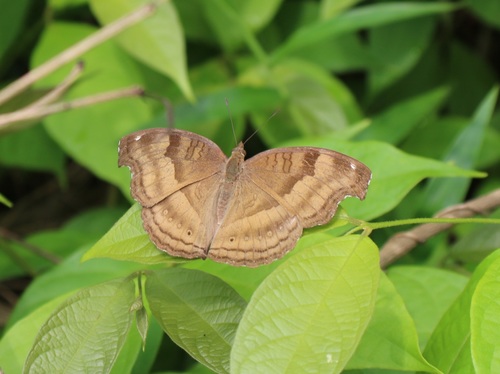
Himalayan Giant Honey Bee

Himalayan Giant Honey Bee

Apis laboriosa

Daily sighting probability ~30% · Possible
at Langtang National Park

In 3 days ~70% in a week ~90%

21 Verified sightings at Langtang National Park From 2019 to 2026
33 In all 2 parks
June Best month
☀️ Diurnal When it's spotted

About the Himalayan Giant Honey Bee

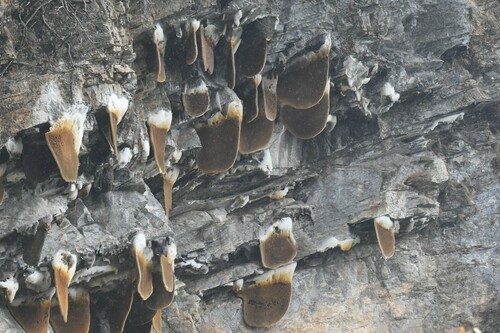
Apis laboriosa or Himalayan giant honey bee, is the world's largest honey bee; single adults can measure up to 3.0 cm (1.2 in) in length. Before 1980, Apis laboriosa was considered to be a subspecies of the widespread Apis dorsata, the giant honey bee, but in 1980 and for almost 20 years thereafter it was elevated to the rank of a separate species. It was classified once again as a subspecies of Apis dorsata by Michael S. Engel in 1999, but was confirmed as a full species in 2020 on the basis of co-occurrence with Apis dorsata at many sites with no sign of interbreeding. It is highly adapted to its highland habitat in behavior.

Recent research has removed laboriosa from inclusion within A. dorsata, as a separate species, with supporting evidence including a significant region of sympatry. A. laboriosa is hardly distinct morphologically from the nominate subspecies of dorsata (darker abdomen, longer thoracic hair) but has different housekeeping and swarming behavior, allowing it to survive at high altitudes. In addition, little gene flow has occurred between A. dorsata and A. laboriosa for millions of years; accordingly, some authors had previously classified it as a distinct... Wikipedia →

Global Distribution

Parks Where Found

# Park Country Daily sighting probability
1 Royal Manas National Park 🇧🇹 Bhutan
~40%
2 Langtang National Park 🇳🇵 Nepal
~30%

Before you go

What are the chances of seeing a Himalayan Giant Honey Bee in Langtang National Park?

Possible

About 30% of wildlife watchers report a Himalayan Giant Honey Bee sighting in Langtang National Park on a given day, based on 21 verified sightings from GBIF citizen-science data from 2019 to 2026. It is the 2nd most-seen of the 6 insects we can rate there. Over three days the chance rises to about 70%, and over a week to about 90%, if each day is a fresh chance.

When is the best time to see a Himalayan Giant Honey Bee in Langtang National Park?

June

In that month about 50% of wildlife watchers report a Himalayan Giant Honey Bee in Langtang National Park on a given day, against about 10% in July and December–January, the lowest months. That is one of Langtang National Park's wettest months, with about 220 mm of rain against 10 mm in November. August and September have too few records to rate.

What time of day is best to see a Himalayan Giant Honey Bee?

Between 10 am and 1 pm

Across all the parks we cover, that three-hour window holds the most Himalayan Giant Honey Bee sightings with a recorded time, and about 9 in 10 of them come between 6 am and 6 pm: it is a daytime animal.

Is Langtang National Park the best place to see a Himalayan Giant Honey Bee?

2nd of 2

Of the 2 parks where we can rate Himalayan Giant Honey Bee sightings, Langtang National Park ranks 2nd at about 30%. The best odds are in Royal Manas National Park (Bhutan, about 40%).

Where does the Himalayan Giant Honey Bee sighting chance come from?

GBIF citizen-science records

It is estimated from how often the Himalayan Giant Honey Bee is recorded against all the insects logged in Langtang National Park (21 verified sightings from 2019 to 2026), calibrated against known sighting rates. Figures are rounded to the nearest 10% because citizen-science data supports honest approximations, not decimals, and months with records from fewer than five people show "—". How it works.

← Back to Langtang National Park