Rufous-bellied Woodpecker

Rufous-bellied Woodpecker

Dendrocopos hyperythrus

Silhouette: Steven Traver · PhyloPic

LCLeast ConcernNTVUENCR
Daily sighting probability ~10% · With luck
at Langtang National Park

In 3 days ~20% in a week ~40%

22 Verified sightings at Langtang National Park From 2019 to 2026
22 In 1 park
April Best month
☀️ Diurnal When it's spotted

About the Rufous-bellied Woodpecker

The rufous-bellied woodpecker or rufous-bellied sapsucker (Dendrocopos hyperythrus) is a species of bird in the family Picidae. This woodpecker has a habit of making a series of small pits on the bark of trees leading to its being considered an Asiatic member of the sapsuckers in the past. It is found along the Himalayas in the Indian subcontinent and Southeast Asia, ranging across Bangladesh, Bhutan, Cambodia, Hong Kong, India, Korea, Myanmar, Nepal, Thailand, Manchuria, Ussuriland and Vietnam. Its natural habitats are subtropical or tropical moist lowland forests and subtropical or tropical moist montane forests.

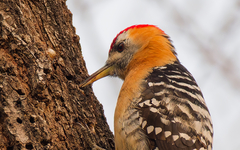
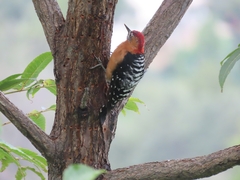
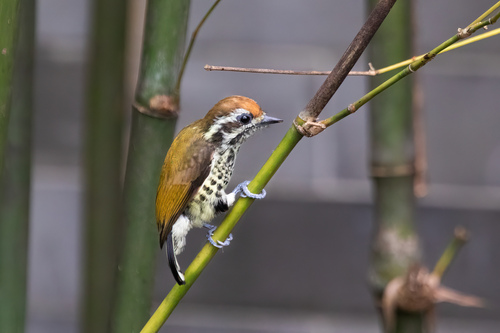
The rufous-bellied woodpecker ranges in length from about 19 to 23 cm (7.5 to 9.1 in). The male has a red crown while the female has a black crown, speckled with white. Both sexes have a black mantle and back, while the wings are black barred with white. The upper tail is black, with some white barring on the outer two pairs of feathers. The face is white and the throat and underparts are a uniform cinnamon or rufous. The lower belly is black barred with white and the under-tail converts are red or pink. The iris is chestnut, the upper mandible of the beak... Wikipedia →

Sounds

Call0:41

India · 2024

© Lars Lachmann · XC893916 · CC BY-NC-SA 4.0

Drumming0:33

Bhutan · 2020

© Langur Eco Travels, bhutanbiridngtours.com · XC613227 · CC BY-NC-SA 4.0

Non-vocal0:20

India · 2019

© Andrew Spencer · XC547677 · CC BY-NC-ND 4.0

Global Distribution

Parks Where Found

# Park Country Daily sighting probability
1 Langtang National Park 🇳🇵 Nepal
~10%

More parks will be added in future updates.

Cities Where Found

# City Country Daily sighting probability
1 Guiyang 🇨🇳 China
~10%
2 Nanjing 🇨🇳 China
~10%
3 Chengdu 🇨🇳 China
~10%
4 Wuhan 🇨🇳 China
<5%
5 Beijing 🇨🇳 China
<5%

Before you go

What are the chances of seeing a Rufous-bellied Woodpecker in Langtang National Park?

With luck

About 10% of wildlife watchers report a Rufous-bellied Woodpecker sighting in Langtang National Park on a given day, based on 22 verified sightings from GBIF citizen-science data from 2019 to 2026. It is the 127th most-seen of the 225 birds we can rate there. Over three days the chance rises to about 20%, and over a week to about 40%, if each day is a fresh chance.

When is the best time to see a Rufous-bellied Woodpecker in Langtang National Park?

February–May and October

In those months about 10% of wildlife watchers report a Rufous-bellied Woodpecker in Langtang National Park on a given day, against under 5% in June–September and November–January, the lowest months. Those are among Langtang National Park's driest months, with about 70 mm of rain a month against 390 mm in July.

What time of day is best to see a Rufous-bellied Woodpecker?

Between 9 am and noon

Across all the parks we cover, that three-hour window holds the most Rufous-bellied Woodpecker sightings with a recorded time, and about 9 in 10 of them come between 6 am and 6 pm: it is a daytime animal.

Where else can you see a Rufous-bellied Woodpecker?

Only Langtang National Park, in our data

Langtang National Park is the only park on Wallace's Line with enough records to rate Rufous-bellied Woodpecker sightings: about 10% of wildlife watchers there report one on a given day.

Where does the Rufous-bellied Woodpecker sighting chance come from?

GBIF citizen-science records

It is estimated from how often the Rufous-bellied Woodpecker is recorded against all the birds logged in Langtang National Park (22 verified sightings from 2019 to 2026), calibrated against known sighting rates. Figures are rounded to the nearest 10% because citizen-science data supports honest approximations, not decimals, and months with records from fewer than five people show "—". How it works.

← Back to Langtang National Park