Giant Conebill

Giant Conebill

Conirostrum binghami

Silhouette: Sheatherius · PhyloPic

LCNTNear ThreatenedVUENCR
Daily sighting probability <5% · Rare
at Lauca National Park

In 3 days ~10% in a week ~20%

26 Verified sightings at Lauca National Park From 2019 to 2026
26 In 1 park
July Best month
☀️ Diurnal When it's spotted

About the Giant Conebill

The giant conebill (Conirostrum binghami) is a small passerine bird, one of the tanager family. It is closely related to the regular conebills Conirostrum though it differs in its larger size and nuthatch-like foraging habits.

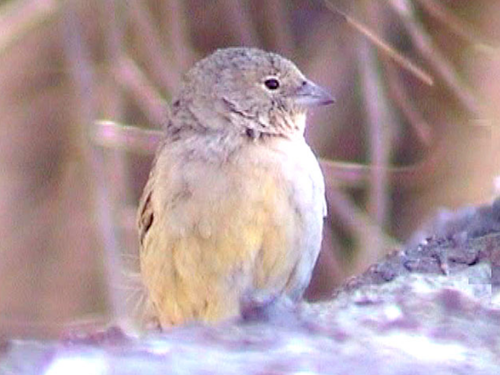
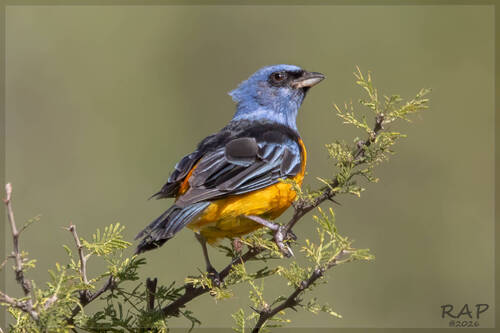
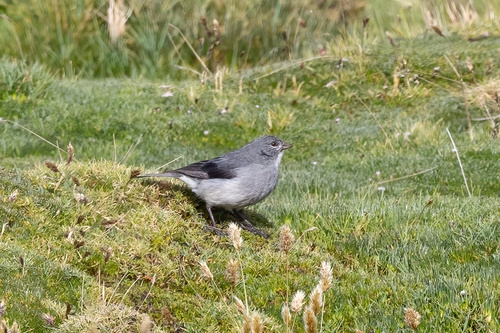
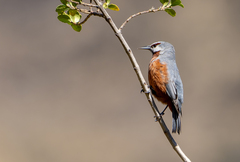
The giant conebill is 15 centimetres (5.9 in) in length and weighs 22–27 grams (0.78–0.95 oz). It is grey above, deep chestnut below, and with a white patch on the cheeks. It is found in the Andes from Colombia to Ecuador, and Peru to Bolivia. It lives in Polylepis trees of the family Rosaceae.

The giant conebill lives individually or in groups of 5 or less. It peels bark off Polylepis trees to find insects. It also eats aphids and sugary solutions secreted by Gynoxys. The species is a seasonal breeder, nesting at the start of the rainy season (September to December in Bolivia where it has been studied). The nest is an open cup set on the branches of Polylepis, and the average clutch size is 1.8 eggs. Both parents incubate the eggs, feed the chicks and remove the fecal sacs.

Its decline is attributed to the destruction and fragmentation of Polylepis woodland. The taxonomy is complicated. The giant conebill was formally described in 1860 by the... Wikipedia →

Sounds

Song0:24

Chile · 2020

© Cristian Pinto · XC581532 · CC BY-NC-SA 4.0

Flight call0:07

Ecuador · 2000

© John V. Moore · XC259536 · CC BY-NC-SA 4.0

Call0:09

Ecuador · 2010

© Ian Davies · XC76272 · CC BY-NC-ND 2.5

Global Distribution

Parks Where Found

# Park Country Daily sighting probability
1 Lauca National Park 🇨🇱 Chile
<5%

More parks will be added in future updates.

Before you go

What are the chances of seeing a Giant Conebill in Lauca National Park?

Rare

Under 5% of wildlife watchers report a Giant Conebill sighting in Lauca National Park on a given day, based on 26 verified sightings from GBIF citizen-science data from 2019 to 2026. It is the 99th most-seen of the 112 birds we can rate there. Over three days the chance rises to about 10%, and over a week to about 20%, if each day is a fresh chance.

When is the best time to see a Giant Conebill in Lauca National Park?

July

In that month about 20% of wildlife watchers report a Giant Conebill in Lauca National Park on a given day, against under 5% in April and August–February, the lowest months. That is one of Lauca National Park's driest months, with about 5 mm of rain against 150 mm in January.

What time of day is best to see a Giant Conebill?

Between 9 am and noon

Across all the parks we cover, that three-hour window holds the most Giant Conebill sightings with a recorded time, and about 9 in 10 of them come between 6 am and 6 pm: it is a daytime animal.

Where else can you see a Giant Conebill?

Only Lauca National Park, in our data

Lauca National Park is the only park on Wallace's Line with enough records to rate Giant Conebill sightings: under 5% of wildlife watchers there report one on a given day.

Where does the Giant Conebill sighting chance come from?

GBIF citizen-science records

It is estimated from how often the Giant Conebill is recorded against all the birds logged in Lauca National Park (26 verified sightings from 2019 to 2026), calibrated against known sighting rates. Figures are rounded to the nearest 10% because citizen-science data supports honest approximations, not decimals, and months with records from fewer than five people show "—". How it works.

← Back to Lauca National Park