

Giant Coot

Giant Coot

Fulica gigantea

Silhouette: Andy Wilson · PhyloPic

LCLeast ConcernNTVUENCR
Daily sighting probability ~60% · Likely
at Lauca National Park

In 3 days ~90% in a week >90%

1,008 Verified sightings at Lauca National Park From 2019 to 2026
1,008 In 1 park
April Best month
☀️ Diurnal When it's spotted

About the Giant Coot

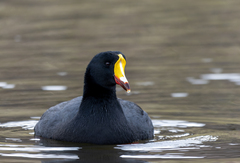
The giant coot (Fulica gigantea) is a species of bird in subfamily Rallinae of family Rallidae, the rails, gallinules, and coots. It is found in Argentina, Bolivia, Chile, and Peru. The giant coot is monotypic. The giant coot is the second largest extant member of family Rallidae, after the takahē of New Zealand. Adults are 48 to 59 cm (19 to 23 in) long. They weigh about 2,000 to 2,500 g (4.4 to 5.5 lb) and are too heavy to fly, though immature birds are smaller and readily fly. The sexes are alike. Adults have a bulky body and a disproportionately small head. Their plumage is deep slaty gray that is blacker on the head and neck. Their undertail coverts have some white streaking. Their bill is deep red with some yellow at the base of the maxilla, their frontal shield is yellow, and unique among coots their legs and feet are deep red. Immature birds have dark gray underparts and a paler bill and legs than adults. Juveniles are dark dull gray with some white on the face and dusky legs.

The giant coot is found from southern Peru through western Bolivia into northern Chile and northwestern Argentina. It is... Wikipedia →

Sounds

Call1:11

Chile · 2019

© Cristian Pinto Fernandez · XC685544 · CC BY-NC-SA 4.0

Alarm call1:20

Chile · 2019

© Cristian Pinto · XC498677 · CC BY-NC-SA 4.0

Song0:26

Chile · 1978

© Guillermo Egli · XC53867 · CC BY-NC-ND 2.5

Global Distribution

Parks Where Found

# Park Country Daily sighting probability
1 Lauca National Park 🇨🇱 Chile
~60%

More parks will be added in future updates.

Before you go

What are the chances of seeing a Giant Coot in Lauca National Park?

Likely

About 60% of wildlife watchers report a Giant Coot sighting in Lauca National Park on a given day, based on 1,008 verified sightings from GBIF citizen-science data from 2019 to 2026. It is the 7th most-seen of the 112 birds we can rate there. Over three days the chance rises to about 90%, and over a week to over 90%, if each day is a fresh chance.

When is the best time to see a Giant Coot in Lauca National Park?

February, April and July

In those months about 70% of wildlife watchers report a Giant Coot in Lauca National Park on a given day, against about 50% in May, August–September and November–December, the lowest months.

What time of day is best to see a Giant Coot?

Between 1 and 4 pm

Across all the parks we cover, that three-hour window holds the most Giant Coot sightings with a recorded time, and about 9 in 10 of them come between 6 am and 6 pm: it is a daytime animal.

Where else can you see a Giant Coot?

Only Lauca National Park, in our data

Lauca National Park is the only park on Wallace's Line with enough records to rate Giant Coot sightings: about 60% of wildlife watchers there report one on a given day.

Where does the Giant Coot sighting chance come from?

GBIF citizen-science records

It is estimated from how often the Giant Coot is recorded against all the birds logged in Lauca National Park (1,008 verified sightings from 2019 to 2026), calibrated against known sighting rates. Figures are rounded to the nearest 10% because citizen-science data supports honest approximations, not decimals, and months with records from fewer than five people show "—". How it works.

← Back to Lauca National Park