Rufous-headed Chachalaca

Rufous-headed Chachalaca

Ortalis erythroptera

Silhouette: PhyloPic

LCNTVUVulnerableENCR
Daily sighting probability ~30% · Possible
at Machalilla National Park

In 3 days ~70% in a week ~90%

252 Verified sightings at Machalilla National Park From 2019 to 2026
252 In 1 park
December Best month
☀️ Diurnal When it's spotted

About the Rufous-headed Chachalaca

The rufous-headed chachalaca (Ortalis erythroptera) is a species of bird in the family Cracidae, the chachalacas, guans, and curassows. It is found in Colombia, Ecuador, and Peru. The rufous-headed chachalaca is monotypic.

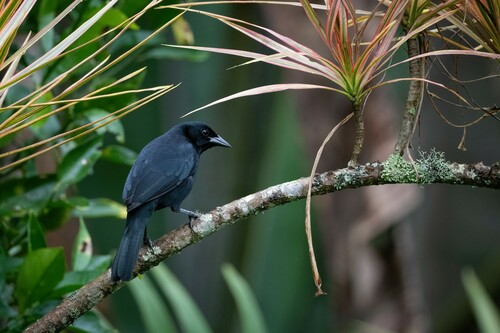
The rufous-headed chachalaca is 56 to 66 cm (1.8 to 2.2 ft) long and weighs 620 to 645 g (1.4 to 1.4 lb). It has a rufous head and neck and gray-brown back. The central tail feathers are dark gray and the outer ones gray near the body and chestnut on their outer halves. The lower breast and belly are creamy white. The primary flight feathers are bright chestnut. Its brown eye is surrounded by bare bluish gray skin. The legs are pale blue.

The rufous-headed chachalaca is found in extreme southwestern Colombia, extreme northwestern Peru, and in several small to medium-sized areas in western Ecuador. It inhabits dry, but not arid, deciduous forest and cloudforest in the coastal zone and Andean foothills. There are unconfirmed reports from savannah and brushy habitats. In elevation it generally ranges from sea level to 1,390 m (4,560 ft) but has been seen as high as 1,850 m (6,070 ft) and... Wikipedia →

Sounds

Dawn song0:23

Ecuador · 2021

© Manuel Sánchez-Nivicela · XC1162778 · CC BY-NC-ND 4.0

Call1:13

Ecuador · 2022

© Bobby Wilcox · XC714907 · CC BY-NC-SA 4.0

Alarm call0:27

Ecuador · 2022

© Jerome Fischer · XC704724 · CC BY-NC-SA 4.0

Global Distribution

Parks Where Found

# Park Country Daily sighting probability
1 Machalilla National Park 🇪🇨 Ecuador
~30%

More parks will be added in future updates.

Zoos & Centres Where Found

# Zoo / Centre Country
1 Amaru 🇪🇨 Ecuador In captivity
2 Zoo. La Isla del Tapir 🇪🇨 Ecuador In captivity
3 Ecozoológico San Martín 🇪🇨 Ecuador In captivity

Before you go

What are the chances of seeing a Rufous-headed Chachalaca in Machalilla National Park?

Possible

About 30% of wildlife watchers report a Rufous-headed Chachalaca sighting in Machalilla National Park on a given day, based on 252 verified sightings from GBIF citizen-science data from 2019 to 2026. It is the 27th most-seen of the 248 birds we can rate there. Over three days the chance rises to about 70%, and over a week to about 90%, if each day is a fresh chance.

When is the best time to see a Rufous-headed Chachalaca in Machalilla National Park?

December

In that month about 50% of wildlife watchers report a Rufous-headed Chachalaca in Machalilla National Park on a given day, against about 20% in February, May–July, September and November, the lowest months. That is one of Machalilla National Park's driest months, with about 25 mm of rain against 140 mm in February.

What time of day is best to see a Rufous-headed Chachalaca?

Between 7 and 10 am

Across all the parks we cover, that three-hour window holds the most Rufous-headed Chachalaca sightings with a recorded time, and about 8 in 10 of them come between 6 am and 6 pm: it is a daytime animal.

Where else can you see a Rufous-headed Chachalaca?

Only Machalilla National Park, in our data

Machalilla National Park is the only park on Wallace's Line with enough records to rate Rufous-headed Chachalaca sightings: about 30% of wildlife watchers there report one on a given day.

Where does the Rufous-headed Chachalaca sighting chance come from?

GBIF citizen-science records

It is estimated from how often the Rufous-headed Chachalaca is recorded against all the birds logged in Machalilla National Park (252 verified sightings from 2019 to 2026), calibrated against known sighting rates. Figures are rounded to the nearest 10% because citizen-science data supports honest approximations, not decimals, and months with records from fewer than five people show "—". How it works.

← Back to Machalilla National Park