Tumbes Round Ray

Tumbes Round Ray

Urobatis tumbesensis

Silhouette: M Kolmann · PhyloPic

Daily sighting probability ~40% · Likely
at Machalilla National Park

In 3 days ~80% in a week >90%

13 Verified sightings at Machalilla National Park From 2019 to 2026
13 In 1 park
December Best month
☀️ Diurnal When it's spotted

About the Tumbes Round Ray

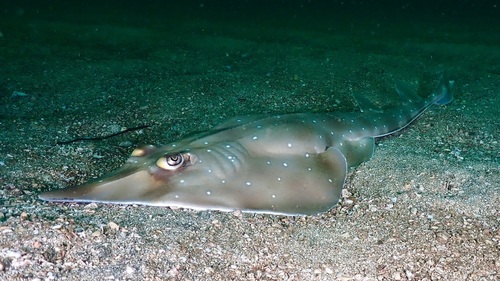
The Tumbes round stingray (Urobatis tumbesensis) is a little-known species of round ray, family Urolophidae, known only from two immature male specimens collected from estuarine waters at depths of 1–2 m, and a third specimen collected in 2006 near mangroves. Its range appears to be limited to coastal waters off Tumbes in northern Peru, where it is found partially buried in sand or mud. The larger of the original two specimens measured 40.4 cm long and the smaller 15.7 cm.

Like other round rays, the Tumbes round stingray has a rounded pectoral fin disc, slightly wider than it is long. The tail is stout, bearing a serrated stinging spine, and terminates in a rounded caudal fin. The pelvic fins have abruptly rounded tips. The teeth have narrowly oval bases and no elevated cusps. The dorsal surface is covered uniformly by dermal denticles on stellate bases, becoming larger towards the midline of the disc; the underside is smooth. There are also thorns on the dorsal surface of the disc and tail. The dorsal coloration consists of ochre vermiculations separating brownish-white oval or circular spots about the size of the eye, becoming more distinct towards the margin of the disc and on the pelvic fins. The denticles and tail spine are ochre-colored, and the underside is light tan with a dark border along the edge of the disc. The coloration, denticles and several proportional measurements distinguish the Tumbes round stingray from other Urobatis species.

Due to its highly restricted distribution and shallow inshore habitat, this species merits conservation concern. Information is needed on whether this species is being affected by fisheries activities in its range. Wikipedia →

Global Distribution

Parks Where Found

# Park Country Daily sighting probability
1 Machalilla National Park 🇪🇨 Ecuador
~40%

More parks will be added in future updates.

Before you go

What are the chances of seeing a Tumbes Round Ray in Machalilla National Park?

Likely

About 40% of wildlife watchers report a Tumbes Round Ray sighting in Machalilla National Park on a given day, based on 13 verified sightings from GBIF citizen-science data from 2019 to 2026. Over three days the chance rises to about 80%, and over a week to over 90%, if each day is a fresh chance.

What time of day is best to see a Tumbes Round Ray?

Between 10 am and 1 pm

Across all the parks we cover, that three-hour window holds the most Tumbes Round Ray sightings with a recorded time, and about 7 in 10 of them come between 6 am and 6 pm: it is a daytime animal.

Where else can you see a Tumbes Round Ray?

Only Machalilla National Park, in our data

Machalilla National Park is the only park on Wallace's Line with enough records to rate Tumbes Round Ray sightings: about 40% of wildlife watchers there report one on a given day.

Where does the Tumbes Round Ray sighting chance come from?

GBIF citizen-science records

It is estimated from how often the Tumbes Round Ray is recorded against all the sharks and rays logged in Machalilla National Park (13 verified sightings from 2019 to 2026), calibrated against known sighting rates. Figures are rounded to the nearest 10% because citizen-science data supports honest approximations, not decimals, and months with records from fewer than five people show "—". How it works.

← Back to Machalilla National Park