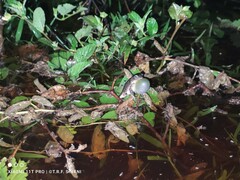
Chaco Granulated Toad

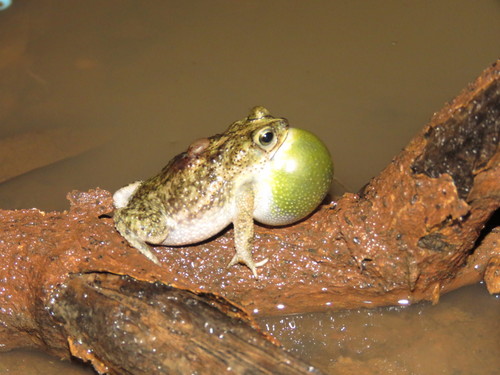
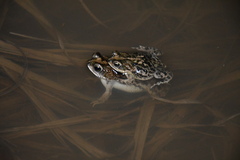
Chaco Granulated Toad

Rhinella major

Silhouette: Dennis C. Murphy, after http://bit.ly/4q6IESe · PhyloPic

LCLeast ConcernNTVUENCR
Daily sighting probability ~20% · Possible
at Madidi National Park

In 3 days ~60% in a week ~80%

6 Verified sightings at Madidi National Park From 2019 to 2026
6 In 1 park
October Best month
🌙 Nocturnal When it's spotted

About the Chaco Granulated Toad

Rhinella, commonly known as South American toads, beaked toads or Rio Viejo toads, is a genus of true toads native to Neotropical parts of Mexico, Central and South America. Additionally, the cane toad has been Introduced to Australia, the Caribbean, the Philippines and elsewhere.

Originally, all species of the genus Rhinella were included in the genus Bufo, then they were split into the genera Chaunus and Rhamphophryne. However, Chaunus and Rhamphophryne are now considered synonyms of Rhinella. Rhinella means 'little nose', from rhino- (ῥῑνο-), the combining form of the Ancient Greek rhis (ῥίς, 'nose') and the Latin diminutive suffix -ella.

Chaunus is the Latinised form of the Ancient Greek chaûnos (χαῦνος, 'porous, spongy'). Rhamphophryne, meaning "beaked toad", is from rhamphos (ῥάµϕος, 'beak') and phrunē (φρύνη, 'toad'). There are about 94 living species recognised in the genus Rhinella:

Frost, Darrel (2006). "The Amphibian Tree of Life". Bulletin of the American Museum of Natural History 297: 1–371. Data related to Rhinella at Wikispecies
Wikipedia →

Sounds

Recording0:20

Brazil · 2024

© Arnaud Aury · XC952400 · CC BY-NC-SA 4.0

Recording0:19

Brazil · 2024

© Augustin Bussac · XC929071 · CC BY-NC-SA 4.0

Global Distribution

Parks Where Found

# Park Country Daily sighting probability
1 Madidi National Park 🇧🇴 Bolivia
~20%

More parks will be added in future updates.

Cities Where Found

# City Country Daily sighting probability
1 Santa Cruz de la Sierra 🇧🇴 Bolivia
~20%

Before you go

What are the chances of seeing a Chaco Granulated Toad in Madidi National Park?

Possible

About 20% of wildlife watchers report a Chaco Granulated Toad sighting in Madidi National Park on a given day, based on 6 verified sightings from GBIF citizen-science data from 2019 to 2026. Over three days the chance rises to about 60%, and over a week to about 80%, if each day is a fresh chance.

When is the best time to see a Chaco Granulated Toad in Madidi National Park?

October

In that month about 40% of wildlife watchers report a Chaco Granulated Toad in Madidi National Park on a given day, against under 5% in June and November, the lowest months.

What time of day is best to see a Chaco Granulated Toad?

Between 7 and 10 pm

Across all the parks we cover, that three-hour window holds the most Chaco Granulated Toad sightings with a recorded time, and about 9 in 10 of them come between 6 pm and 6 am: it is mostly seen at night.

Where else can you see a Chaco Granulated Toad?

Only Madidi National Park, in our data

Madidi National Park is the only park on Wallace's Line with enough records to rate Chaco Granulated Toad sightings: about 20% of wildlife watchers there report one on a given day.

Where does the Chaco Granulated Toad sighting chance come from?

GBIF citizen-science records

It is estimated from how often the Chaco Granulated Toad is recorded against all the amphibians logged in Madidi National Park (6 verified sightings from 2019 to 2026), calibrated against known sighting rates. Figures are rounded to the nearest 10% because citizen-science data supports honest approximations, not decimals, and months with records from fewer than five people show "—". How it works.

← Back to Madidi National Park