Mato Grosso Antbird

Mato Grosso Antbird

Cercomacra melanaria

Silhouette: Sheatherius · PhyloPic

LCLeast ConcernNTVUENCR
Daily sighting probability <5% · Rare
at Madidi National Park

In 3 days ~10% in a week ~20%

5 Verified sightings at Madidi National Park From 2019 to 2026
358 In all 2 parks
September Best month
☀️ Diurnal When it's spotted

About the Mato Grosso Antbird

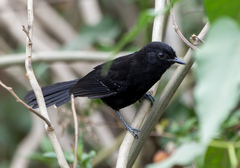
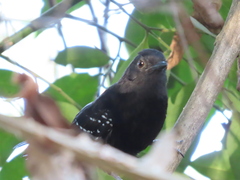
The Mato Grosso antbird (Cercomacra melanaria) is a species of bird in subfamily Thamnophilinae of family Thamnophilidae, the "typical antbirds". It is found in Bolivia, Brazil, and Paraguay. The Mato Grosso antbird was formally described in 1835 by the French zoologist Édouard Ménétries under the binomial name Formicivora melanaria.

The specific epithet is from Latin melania meaning "blackness". The type locality is the town of Cuiabá in the Brazilian state of Mato Grosso. This antbird is now placed in the genus Cercomacra that was introduced by the English zoologist Philip Sclater in 1858. The species is monotypic: No subspecies are recognized.

A 2014 study confirmed what had been earlier suggested, that the Mato Grosso antbird and the bananal (C. ferdinandi), Rio Branco (C. carbonaria), and jet (C. nigricans) antbirds form a clade within genus Cercomacra. The Mato Grosso antbird is 16 to 16.5 cm (6.3 to 6.5 in) long and weighs 18.5 to 19.5 g (0.65 to 0.69 oz). Adult males are almost entirely black, with white edges on their outer scapulars, a white patch between them, and a hidden white patch under them. Their wing coverts and tail...
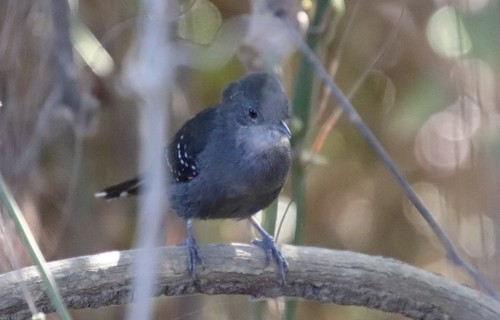
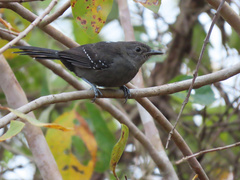
Wikipedia →

Sounds

Duet0:42

Brazil · 2025

© Joost van Bruggen · XC1050512 · CC BY-NC-ND 4.0

Call1:03

Brazil · 2022

© Peder Svingen · XC741477 · CC BY-NC-SA 4.0

Song0:04

Brazil · 2021

© Fernando Igor de Godoy · XC707631 · CC BY-NC-SA 4.0

Global Distribution

Parks Where Found

# Park Country Daily sighting probability
1 Parque Estadual Encontro das Águas 🇧🇷 Brazil
~20%
2 Madidi National Park 🇧🇴 Bolivia
<5%

Before you go

What are the chances of seeing a Mato Grosso Antbird in Madidi National Park?

Rare

Under 5% of wildlife watchers report a Mato Grosso Antbird sighting in Madidi National Park on a given day, based on 5 verified sightings from GBIF citizen-science data from 2019 to 2026. It is the 215th most-seen of the 239 birds we can rate there. Over three days the chance rises to about 10%, and over a week to about 20%, if each day is a fresh chance.

When is the best time to see a Mato Grosso Antbird in Madidi National Park?

January, July and September

In those months about 10% of wildlife watchers report a Mato Grosso Antbird in Madidi National Park on a given day, against under 5% in February, April–June, August and October–November, the lowest months. March and December have too few records to rate.

What time of day is best to see a Mato Grosso Antbird?

Between 8 and 11 am

Across all the parks we cover, that three-hour window holds the most Mato Grosso Antbird sightings with a recorded time, and about 9 in 10 of them come between 6 am and 6 pm: it is a daytime animal.

Is Madidi National Park the best place to see a Mato Grosso Antbird?

2nd of 2

Of the 2 parks where we can rate Mato Grosso Antbird sightings, Madidi National Park ranks 2nd at under 5%. The best odds are in Parque Estadual Encontro das Águas (Brazil, about 20%).

Which relatives of the Mato Grosso Antbird live in Madidi National Park?

Same family: Thamnophilidae

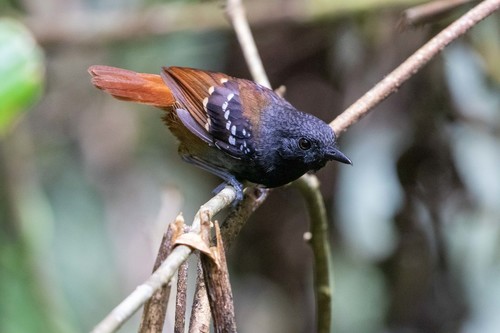
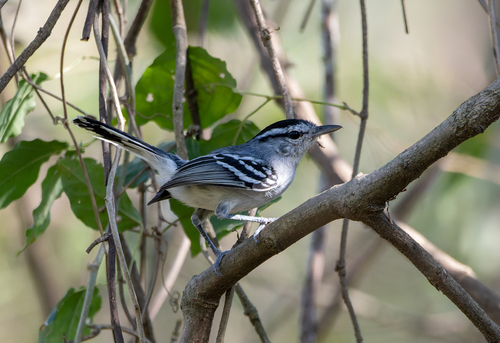
The closest relatives of the Mato Grosso Antbird that you can see in Madidi National Park (family Thamnophilidae, Typical Antbirds) are Great Antshrike (about 40%), Barred Antshrike (about 20%) and Chestnut-tailed Antbird (about 10%), with each one's daily chance of a sighting.

Where does the Mato Grosso Antbird sighting chance come from?

GBIF citizen-science records

It is estimated from how often the Mato Grosso Antbird is recorded against all the birds logged in Madidi National Park (5 verified sightings from 2019 to 2026), calibrated against known sighting rates. Figures are rounded to the nearest 10% because citizen-science data supports honest approximations, not decimals, and months with records from fewer than five people show "—". How it works.

← Back to Madidi National Park