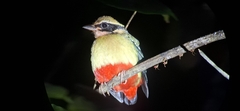
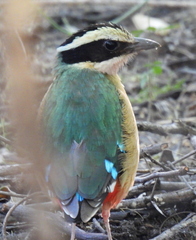
African Pitta

African Pitta

Pitta angolensis

Silhouette: Rachael Joakim · PhyloPic

LCLeast ConcernNTVUENCR
Daily sighting probability ~10% · With luck
at Mana Pools National Park

In 3 days ~30% in a week ~50%

45 Verified sightings at Mana Pools National Park From 2019 to 2026
45 In 1 park
December Best month
🌅 Crepuscular When it's spotted

About the African Pitta

The African pitta (Pitta angolensis) is an Afrotropical bird of the family Pittidae. It is a locally common to uncommon species, resident and migratory in the west, and an intra-African migrant between equatorial and southeastern Africa. They are elusive and hard to observe despite their brightly coloured plumage, and their loud, explosive calls are infrequently heard. The plump, somewhat thrush-like birds forage on leaf litter under the canopy of riparian or coastal forest and thickets, or in climax miombo forest. They spend much time during mornings and at dusk scratching in leaf litter or around termitaria, or may stand motionless for long periods. Following rains breeding birds call and display from the mid-canopy.

The African pitta was described by the French ornithologist Louis Pierre Vieillot in 1816 and given the binomial name Pitta angolensis. Vieillot had introduced the genus Pitta in another book published in the same year. Three subspecies are recognised: Wikipedia →

Sounds

Song0:55

Zambia · 2023

© Dries Van de Loock · XC854347 · CC BY-NC-ND 4.0

Call0:36

Zambia · 2004

© Derek Solomon · XC41319 · CC BY-NC-ND 2.5

Flight call0:19

Liberia · 2021

© Marc Languy · XC629703 · CC BY-NC-SA 4.0

Global Distribution

Parks Where Found

# Park Country Daily sighting probability
1 Mana Pools National Park 🇿🇼 Zimbabwe
~10%

More parks will be added in future updates.

Before you go

What are the chances of seeing an African Pitta in Mana Pools National Park?

With luck

About 10% of wildlife watchers report an African Pitta sighting in Mana Pools National Park on a given day, based on 45 verified sightings from GBIF citizen-science data from 2019 to 2026. It is the 160th most-seen of the 275 birds we can rate there. Over three days the chance rises to about 30%, and over a week to about 50%, if each day is a fresh chance.

When is the best time to see an African Pitta in Mana Pools National Park?

December

In that month about 40% of wildlife watchers report an African Pitta in Mana Pools National Park on a given day, against under 5% in April to October, the lowest months. That is one of Mana Pools National Park's wettest months, with about 140 mm of rain against almost none in August. March has too few records to rate.

What time of day is best to see an African Pitta?

Between 4 and 7 pm

Across all the parks we cover, that three-hour window holds the most African Pitta sightings with a recorded time, and about 6 in 10 of them come between 6 am and 6 pm: it is most active around dawn and dusk.

Where else can you see an African Pitta?

Only Mana Pools National Park, in our data

Mana Pools National Park is the only park on Wallace's Line with enough records to rate African Pitta sightings: about 10% of wildlife watchers there report one on a given day.

Which relatives of the African Pitta live in Mana Pools National Park?

Same order: Passeriformes

The closest relatives of the African Pitta that you can see in Mana Pools National Park (order Passeriformes, Perching Birds) are Meves's Glossy-starling (about 70%), Fork-tailed Drongo (about 60%) and Common Bulbul (about 60%), with each one's daily chance of a sighting.

Where does the African Pitta sighting chance come from?

GBIF citizen-science records

It is estimated from how often the African Pitta is recorded against all the birds logged in Mana Pools National Park (45 verified sightings from 2019 to 2026), calibrated against known sighting rates. Figures are rounded to the nearest 10% because citizen-science data supports honest approximations, not decimals, and months with records from fewer than five people show "—". How it works.

← Back to Mana Pools National Park