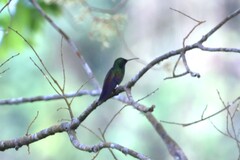
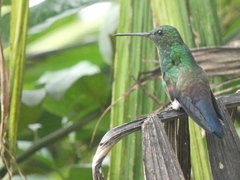

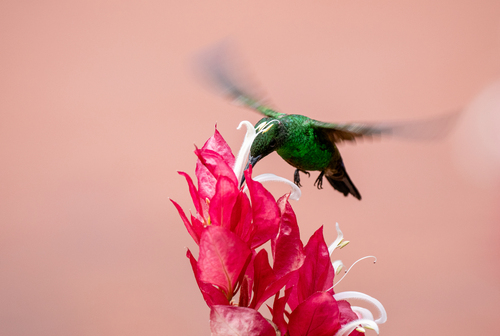
Blue-tailed Hummingbird

Blue-tailed Hummingbird

Saucerottia cyanura

Silhouette: Ferran Sayol · PhyloPic

LCLeast ConcernNTVUENCR
Daily sighting probability <5% · Rare
at Masaya Volcano National Park

In 3 days <5%

5 Verified sightings at Masaya Volcano National Park From 2019 to 2026
5 In 1 park
February Best month
☀️ Diurnal When it's spotted

About the Blue-tailed Hummingbird

The blue-tailed hummingbird (Saucerottia cyanura) is a species of hummingbird in the "emeralds", tribe Trochilini of subfamily Trochilinae. It is found in Costa Rica, El Salvador, Guatemala, Honduras, Mexico, and Nicaragua.

The blue-tailed hummingbird was formerly placed in the genus Amazilia. A molecular phylogenetic study published in 2014 found that the genus Amazilia was polyphyletic. In the revised classification to create monophyletic genera, the blue-tailed hummingbird was moved by most taxonomic systems to the resurrected genus Saucerottia. However, BirdLife International's Handbook of the Birds of the World retains it in Amazilia.

The blue-tailed hummingbird is 9 to 10 cm (3.5 to 3.9 in) long. One male specimen weighed 3.9 g (0.14 oz) and females weigh about 4.5 g (0.16 oz). Both sexes of all subspecies have a black bill with a reddish base to the mandible. Males of the nominate subspecies have a deep metallic green crown and back, a dull purplish bronze rump, and dark metallic bluish uppertail coverts. Their primaries and secondaries... Wikipedia →

Sounds

Call0:33

Guatemala · 2024

© Peter Boesman · XC880282 · CC BY-NC-ND 4.0

Song0:19

Honduras · 2008

© Robert Gallardo · XC24454 · CC BY-NC-ND 2.5

Call0:15

Guatemala · 2013

© Mike Nelson · XC125620 · CC BY-NC-SA 3.0

Global Distribution

Parks Where Found

# Park Country Daily sighting probability
1 Masaya Volcano National Park 🇳🇮 Nicaragua
<5%

More parks will be added in future updates.

Before you go

What are the chances of seeing a Blue-tailed Hummingbird in Masaya Volcano National Park?

Rare

Under 5% of wildlife watchers report a Blue-tailed Hummingbird sighting in Masaya Volcano National Park on a given day, based on 5 verified sightings from GBIF citizen-science data from 2019 to 2026. It is the 131st most-seen of the 134 birds we can rate there. Over three days the chance rises to under 5%, if each day is a fresh chance.

When is the best time to see a Blue-tailed Hummingbird in Masaya Volcano National Park?

Any time of year

In every month with enough records, under 5% of wildlife watchers report a Blue-tailed Hummingbird in Masaya Volcano National Park on a given day, so our monthly data shows no clear season.

What time of day is best to see a Blue-tailed Hummingbird?

Between 9 am and noon

Across all the parks we cover, that three-hour window holds the most Blue-tailed Hummingbird sightings with a recorded time, and about 9 in 10 of them come between 6 am and 6 pm: it is a daytime animal.

Where else can you see a Blue-tailed Hummingbird?

Only Masaya Volcano National Park, in our data

Masaya Volcano National Park is the only park on Wallace's Line with enough records to rate Blue-tailed Hummingbird sightings: under 5% of wildlife watchers there report one on a given day.

Where does the Blue-tailed Hummingbird sighting chance come from?

GBIF citizen-science records

It is estimated from how often the Blue-tailed Hummingbird is recorded against all the birds logged in Masaya Volcano National Park (5 verified sightings from 2019 to 2026), calibrated against known sighting rates. Figures are rounded to the nearest 10% because citizen-science data supports honest approximations, not decimals, and months with records from fewer than five people show "—". How it works.

← Back to Masaya Volcano National Park