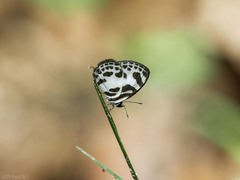
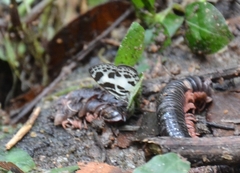
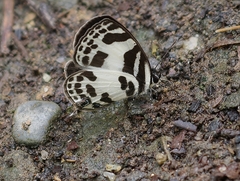
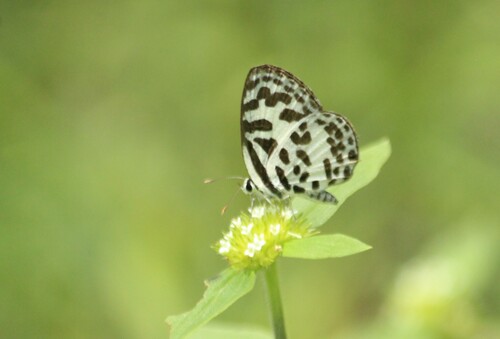
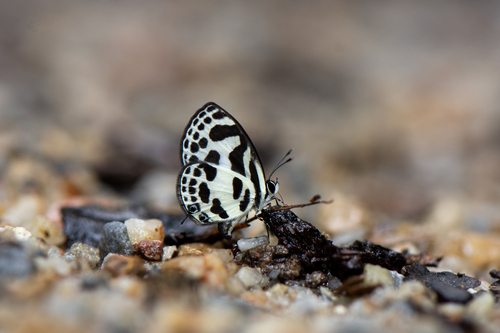
Banded Blue Pierrot

Banded Blue Pierrot

Discolampa ethion

Daily sighting probability ~20% · Possible
at Nagarhole National Park

In 3 days ~50% in a week ~80%

6 Verified sightings at Nagarhole National Park From 2019 to 2026
33 In all 3 parks
November Best month
☀️ Diurnal When it's spotted

About the Banded Blue Pierrot

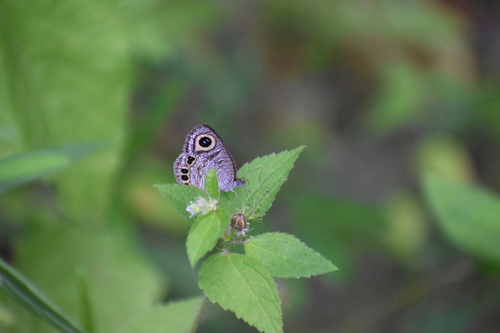
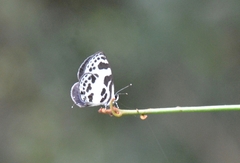
Discolampa ethion, the banded blue Pierrot, is a contrastingly marked butterfly found in South Asia that belongs to the blues or family Lycaenidae. The species was first described by John O. Westwood in 1851. The following description is taken from Charles Thomas Bingham Fauna of British India: Butterflies Volume II (1907).

Male. Upperside, forewings and hindwings: medially and obliquely crossed by a very broad pure white band that is broadly edged on its inner and outer margins by dark blue and does not extend on the forewing above vein 6, just above vein 3 it projects outwards for a short distance whence the inner margin of its dark blue edging is carried obliquely to vein 6; the extreme bases of the wings black; the costal margin of the fore and the terminal margins of both forewings and hindwings broadly black; on both wings a light iridescent blue suffusion from base outwards. Underside: snow-white. Forewings and hindwings: the following jet-black markings: Forewing: two broad more or less parallel streaks from base extended obliquely to the costa, the outer of the two apically curved and on the costa coalescent with the inner streak; costal margin very narrowly... Wikipedia →

Global Distribution

Parks Where Found

# Park Country Daily sighting probability
1 Nagarhole National Park 🇮🇳 India
~20%
2 Taman Negara National Park 🇲🇾 Malaysia
~20%
3 Kaeng Krachan National Park 🇹🇭 Thailand
~10%

Cities Where Found

# City Country Daily sighting probability
1 Mysuru 🇮🇳 India
~10%
2 Kochi 🇮🇳 India
<5%
3 Bengaluru 🇮🇳 India
<5%

Before you go

What are the chances of seeing a Banded Blue Pierrot in Nagarhole National Park?

Possible

About 20% of wildlife watchers report a Banded Blue Pierrot sighting in Nagarhole National Park on a given day, based on 6 verified sightings from GBIF citizen-science data from 2019 to 2026. It is the 8th most-seen of the 18 insects we can rate there. Over three days the chance rises to about 50%, and over a week to about 80%, if each day is a fresh chance.

When is the best time to see a Banded Blue Pierrot in Nagarhole National Park?

November

In that month about 60% of wildlife watchers report a Banded Blue Pierrot in Nagarhole National Park on a given day, against under 5% in August–September and December–June, the lowest months.

What time of day is best to see a Banded Blue Pierrot?

Between 10 am and 1 pm

Across all the parks we cover, that three-hour window holds the most Banded Blue Pierrot sightings with a recorded time, and nearly all of them come between 6 am and 6 pm: it is a daytime animal.

Is Nagarhole National Park the best place to see a Banded Blue Pierrot?

Yes

Of the 3 parks where we can rate Banded Blue Pierrot sightings, Nagarhole National Park has the highest daily chance: about 20%. Next come Taman Negara National Park (Malaysia, about 20%) and Kaeng Krachan National Park (Thailand, about 10%).

Where does the Banded Blue Pierrot sighting chance come from?

GBIF citizen-science records

It is estimated from how often the Banded Blue Pierrot is recorded against all the insects logged in Nagarhole National Park (6 verified sightings from 2019 to 2026), calibrated against known sighting rates. Figures are rounded to the nearest 10% because citizen-science data supports honest approximations, not decimals, and months with records from fewer than five people show "—". How it works.
← Back to Nagarhole National Park