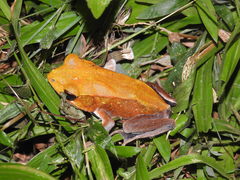
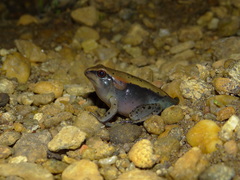
Bicolored Frog

Bicolored Frog

Clinotarsus curtipes

Silhouette: Vijay Karthick · PhyloPic

LCLeast ConcernNTVUENCR Endemic
Daily sighting probability ~40% · Likely
at Nagarhole National Park

In 3 days ~80% in a week >90%

73 Verified sightings at Nagarhole National Park From 2019 to 2026
99 In all 2 parks
April Best month
☀️ Diurnal When it's spotted

About the Bicolored Frog

The bicolored frog or Malabar frog (Clinotarsus curtipes) is a species of frog endemic to the Western Ghats of India. The tadpoles of the species are black and form dense and compact schools in slow moving streams in forested areas.

The bicolored frog's vomerine teeth scarcely developed, sometimes indistinct. The teeth are in two slightly oblique series on a level with the hind edge of the choanae. Its head large; snout short, rounded, with well-marked canthus rostralis and concave loreal region; nostril nearer to the end of the snout than to the eye; interorbital space broader than the upper eyelid; tympanum distinct, nearly as large as the eye. Fingers moderate, first extending beyond second; toes short, nearly entirely webbed; tips of fingers and toes swollen or dilated into very small disks; subarticular tubercles much developed; inner metatarsal tubercle small, oval, blunt; a rather large, flat tubercle at the base of the fourth toe; no tarsal fold. The tibio-tarsal articulation reaches the eye. Skin finely granular above; a moderately prominent, rather narrow glandular lateral fold; another told behind the tympanum down to the shoulder. Clinotarsus curtipes is... Wikipedia →

Global Distribution

Parks Where Found

# Park Country Daily sighting probability
1 Nagarhole National Park 🇮🇳 India
~40%
2 Periyar National Park 🇮🇳 India
~40%

Before you go

What are the chances of seeing a Bicolored Frog in Nagarhole National Park?

Likely

About 40% of wildlife watchers report a Bicolored Frog sighting in Nagarhole National Park on a given day, based on 73 verified sightings from GBIF citizen-science data from 2019 to 2026. It is the most-seen of the 5 amphibians we can rate there. Over three days the chance rises to about 80%, and over a week to over 90%, if each day is a fresh chance.

When is the best time to see a Bicolored Frog in Nagarhole National Park?

April

In that month about 60% of wildlife watchers report a Bicolored Frog in Nagarhole National Park on a given day, against about 20% in March and December–January, the lowest months. That is one of Nagarhole National Park's driest months, with about 50 mm of rain against 270 mm in July.

What time of day is best to see a Bicolored Frog?

Between 3 and 6 pm

Across all the parks we cover, that three-hour window holds the most Bicolored Frog sightings with a recorded time, and about 7 in 10 of them come between 6 am and 6 pm: it is a daytime animal.

Is Nagarhole National Park the best place to see a Bicolored Frog?

Yes

Of the 2 parks where we can rate Bicolored Frog sightings, Nagarhole National Park has the highest daily chance: about 40%. Next come Periyar National Park (India, about 40%).

Which relatives of the Bicolored Frog live in Nagarhole National Park?

Same order: Anura

The closest relatives of the Bicolored Frog that you can see in Nagarhole National Park (order Anura, Frogs and Toads) are Common Indian Toad (about 40%), Indus Valley Bullfrog (about 30%) and winged gliding frog (about 20%), with each one's daily chance of a sighting.

Where does the Bicolored Frog sighting chance come from?

GBIF citizen-science records

It is estimated from how often the Bicolored Frog is recorded against all the amphibians logged in Nagarhole National Park (73 verified sightings from 2019 to 2026), calibrated against known sighting rates. Figures are rounded to the nearest 10% because citizen-science data supports honest approximations, not decimals, and months with records from fewer than five people show "—". How it works.

← Back to Nagarhole National Park