
Burchell's Courser

Burchell's Courser

Cursorius rufus

Silhouette: Sheatherius · PhyloPic

LCLeast ConcernNTVUENCR
Daily sighting probability <5% · Rare
at Namib-Naukluft National Park

In 3 days ~10% in a week ~20%

23 Verified sightings at Namib-Naukluft National Park From 2019 to 2026
91 In all 2 parks
July Best month
☀️ Diurnal When it's spotted

About the Burchell's Courser

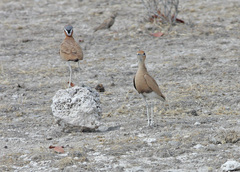
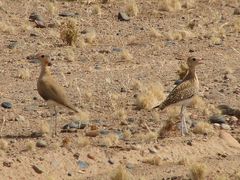
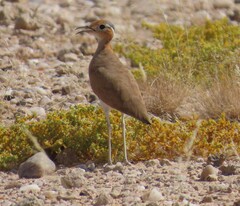
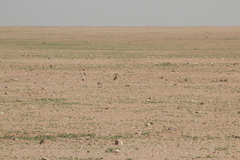
Burchell's courser (Cursorius rufus) is a wader in the pratincole and courser family, Glareolidae. The name of this bird commemorates the English naturalist William John Burchell. Native to Africa, Burchell's courser is a small, diurnal, and terrestrial bird that lives in the western parts of southern Africa. Although classed as waders, these are birds of dry open country, preferably semi-desert, where they typically hunt their insect prey (usually Harvester Termites) by running on the ground. It principally feeds off of insects and lives in open, short grasslands and burnt veld. It grows up to 22 cm (8.7 in) and on average weighs about 75 g (2.6 oz) as an adult.

Burchell's courser has a graceful figure and an upright posture. It has a blue-grey hind crown which is mainly how it differs from the similar Temminck's courser. It also has a horizontal black band demarcating a white underbelly, and an overall pale rufous colour. Its face features white supercilia above black eye lines, all ending at the back of the neck to form a double V. In terms of feathers, its secondaries are mostly white with a black underwing and brown to grey coverts. Typical of coursers, its bill... Wikipedia →

Sounds

Flight call0:13

South Africa · 2020

© Lynette Rudman · XC597244 · CC BY-NC-SA 4.0

Global Distribution

Parks Where Found

# Park Country Daily sighting probability
1 Etosha National Park 🇳🇦 Namibia
<5%
2 Namib-Naukluft National Park 🇳🇦 Namibia
<5%

Before you go

What are the chances of seeing a Burchell's Courser in Namib-Naukluft National Park?

Rare

Under 5% of wildlife watchers report a Burchell's Courser sighting in Namib-Naukluft National Park on a given day, based on 23 verified sightings from GBIF citizen-science data from 2019 to 2026. It is the 81st most-seen of the 108 birds we can rate there. Over three days the chance rises to about 10%, and over a week to about 20%, if each day is a fresh chance.

When is the best time to see a Burchell's Courser in Namib-Naukluft National Park?

January, March–April, July and November

In those months about 10% of wildlife watchers report a Burchell's Courser in Namib-Naukluft National Park on a given day, against under 5% in February, May–June, August–October and December, the lowest months.

What time of day is best to see a Burchell's Courser?

Between 9 am and noon

Across all the parks we cover, that three-hour window holds the most Burchell's Courser sightings with a recorded time, and about 9 in 10 of them come between 6 am and 6 pm: it is a daytime animal.

Is Namib-Naukluft National Park the best place to see a Burchell's Courser?

Among the best

Of the 2 parks where we can rate Burchell's Courser sightings, Namib-Naukluft National Park ranks 2nd at under 5%, level with the leaders once rounded. The best odds are in Etosha National Park (Namibia, under 5%).

Where does the Burchell's Courser sighting chance come from?

GBIF citizen-science records

It is estimated from how often the Burchell's Courser is recorded against all the birds logged in Namib-Naukluft National Park (23 verified sightings from 2019 to 2026), calibrated against known sighting rates. Figures are rounded to the nearest 10% because citizen-science data supports honest approximations, not decimals, and months with records from fewer than five people show "—". How it works.

← Back to Namib-Naukluft National Park