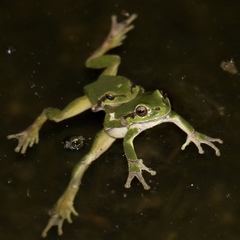
European Tree Frog

European Tree Frog

Hyla arborea

Silhouette: Luca Leicht · PhyloPic

LCLeast ConcernNTVUENCR
Daily sighting probability ~10% · With luck
at Oosterschelde National Park

In 3 days ~30% in a week ~60%

15 Verified sightings at Oosterschelde National Park From 2019 to 2026
218 In all 5 parks
August Best month
☀️ Diurnal When it's spotted

About the European Tree Frog

The European tree frog (Hyla arborea) is a small tree frog. As traditionally defined, it was found throughout much of Europe, Asia and northern Africa, but based on molecular genetic and other data several populations formerly included in it are now recognized as separate species (for example, H. intermedia of Italy and nearby, H. molleri of the Iberian Peninsula, H. meridionalis of parts of southwestern Europe and northern Africa, and H. orientalis of parts of Eastern Europe, Turkey and the Black Sea and Caspian Sea regions), limiting the true European tree frog to Europe from France to Poland and Greece.

European tree frogs are small; males range from 32–43 mm (1.3–1.7 in) in length, and females range from 40–50 mm (1.6–2.0 in) in length. They are slender, with long legs. Their dorsal skin is smooth, while their ventral skin is granular. Their dorsal skin can be green, gray, or tan depending on the temperature, humidity, or their mood. Their ventral skin is a whitish color, and the dorsal and ventral skin is separated by a dark brown lateral stripe from the eyes to the groin. Females have white throats, while males have golden brown throats with large (folded) vocal...

Wikipedia →

Sounds

Advertisement call0:57

Poland · 2025

© Adam Gruszczyński · XC1178215 · CC BY-NC-SA 4.0

Territorial call0:07

France · 2026

© Le Louaver Manuel · XC1152342 · CC BY-NC-SA 4.0

Uncertain1:13

Belgium · 2026

© Alain Malengreau · XC1133014 · CC BY-NC-SA 4.0

Global Distribution

Parks Where Found

# Park Country Daily sighting probability
1 Hortobágy National Park 🇭🇺 Hungary
~50%
2 Kiskunság National Park 🇭🇺 Hungary
~50%
3 Fertő-Hanság National Park 🇭🇺 Hungary
~40%
4 Bavarian Forest National Park 🇩🇪 Germany
~10%
5 Oosterschelde National Park 🇳🇱 Netherlands
~10%

Cities Where Found

# City Country Daily sighting probability
1 Munich 🇩🇪 Germany
~10%
2 Vienna 🇦🇹 Austria
~10%

Zoos & Centres Where Found

# Zoo / Centre Country
1 Skansen 🇸🇪 Sweden In captivity
2 Slimbridge Wetland Centre 🇬🇧 United Kingdom In captivity
3 Wildpark Schwarze Berge 🇩🇪 Germany In captivity
4 Berlin Zoological Garden 🇩🇪 Germany In captivity
5 Universeum 🇸🇪 Sweden In captivity
6 Freiland-Aquarium und -Terrarium Stein 🇩🇪 Germany In captivity
7 Aquarium Berlin 🇩🇪 Germany In captivity
8 Fluviário de Mora 🇵🇹 Portugal In captivity
9 Baltic Sea Science Center 🇸🇪 Sweden In captivity
10 Lake Tisza Ecocentre 🇭🇺 Hungary In captivity
11 Löbbecke Museum und Aquazoo 🇩🇪 Germany In captivity

Before you go

What are the chances of seeing a European Tree Frog in Oosterschelde National Park?

With luck

About 10% of wildlife watchers report a European Tree Frog sighting in Oosterschelde National Park on a given day, based on 15 verified sightings from GBIF citizen-science data from 2019 to 2026. Over three days the chance rises to about 30%, and over a week to about 60%, if each day is a fresh chance.

When is the best time to see a European Tree Frog in Oosterschelde National Park?

August

In that month about 30% of wildlife watchers report a European Tree Frog in Oosterschelde National Park on a given day, against under 5% in June and November–April, the lowest months.

What time of day is best to see a European Tree Frog?

Between 11 am and 2 pm

Across all the parks we cover, that three-hour window holds the most European Tree Frog sightings with a recorded time, and about 8 in 10 of them come between 6 am and 6 pm: it is a daytime animal.

Where does the European Tree Frog sighting chance come from?

GBIF citizen-science records

It is estimated from how often the European Tree Frog is recorded against all the amphibians logged in Oosterschelde National Park (15 verified sightings from 2019 to 2026), calibrated against known sighting rates. Figures are rounded to the nearest 10% because citizen-science data supports honest approximations, not decimals, and months with records from fewer than five people show "—". How it works.

← Back to Oosterschelde National Park