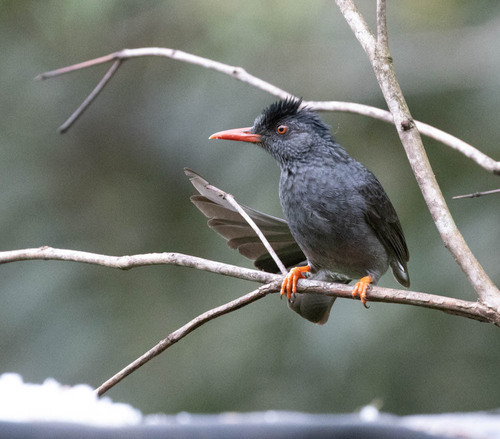
Flame-throated Bulbul

Flame-throated Bulbul

Pycnonotus gularis

LCLeast ConcernNTVUENCR Endemic
Daily sighting probability ~20% · Possible
at Periyar National Park

In 3 days ~40% in a week ~70%

364 Verified sightings at Periyar National Park From 2019 to 2026
415 In all 3 parks
January Best month
☀️ Diurnal When it's spotted

About the Flame-throated Bulbul

The flame-throated bulbul (Rubigula gularis) is a member of the bulbul family of passerine birds and the state bird of Goa. It is found only in the forests of the Western Ghats in southern India. Formerly included as a subspecies of Pycnonotus flaviventris, it has since been elevated to the status of a full species. They are olive-backed with yellow undersides, a triangular orange-red throat and a white iris that stands out against the contrasting black head. They are usually seen foraging in groups in the forest canopy for berries and small insects. They have a call often with two or three tinkling notes that can sound similar to those produced by the red-whiskered bulbul. The species has been referred to in the past by names such as ruby-throated bulbul and black-headed bulbul, but these are ambiguous and could apply to other species such as Rubigula flaviventris and R. dispar.

The species was described by John Gould in December 1835 (but published in 1836) based on a specimen in the Zoological Society of London that had been obtained from Travancore State. Gould noted that it was very similar to Brachypus dispar (now Rubigula dispar) that had been... Wikipedia →

Sounds

Subsong0:40

India · 2023

© Sathyan Meppayur · XC786581 · CC BY-NC-SA 4.0

Song0:27

India · 2023

© JISHNU KIZHAKKILLAM · XC783987 · CC BY-NC-SA 4.0

Uncertain0:15

India · 2020

© Vijay Ramesh · XC619724 · CC BY-NC-SA 4.0

Global Distribution

Parks Where Found

# Park Country Daily sighting probability
1 Periyar National Park 🇮🇳 India
~20%
2 Nagarhole National Park 🇮🇳 India
<5%
3 Eravikulam National Park 🇮🇳 India
<5%

Before you go

What are the chances of seeing a Flame-throated Bulbul in Periyar National Park?

Possible

About 20% of wildlife watchers report a Flame-throated Bulbul sighting in Periyar National Park on a given day, based on 364 verified sightings from GBIF citizen-science data from 2019 to 2026. It is the 86th most-seen of the 227 birds we can rate there. Over three days the chance rises to about 40%, and over a week to about 70%, if each day is a fresh chance.

When is the best time to see a Flame-throated Bulbul in Periyar National Park?

January to March

In those months about 20% of wildlife watchers report a Flame-throated Bulbul in Periyar National Park on a given day, against under 5% in May to July, the lowest months. Those are among Periyar National Park's driest months, with about 30 mm of rain a month against 410 mm in August.

What time of day is best to see a Flame-throated Bulbul?

Between 7 and 10 am

Across all the parks we cover, that three-hour window holds the most Flame-throated Bulbul sightings with a recorded time, and about 9 in 10 of them come between 6 am and 6 pm: it is a daytime animal.

Is Periyar National Park the best place to see a Flame-throated Bulbul?

Yes

Of the 3 parks where we can rate Flame-throated Bulbul sightings, Periyar National Park has the highest daily chance: about 20%. Next come Nagarhole National Park (India, under 5%) and Eravikulam National Park (India, under 5%).

Where does the Flame-throated Bulbul sighting chance come from?

GBIF citizen-science records

It is estimated from how often the Flame-throated Bulbul is recorded against all the birds logged in Periyar National Park (364 verified sightings from 2019 to 2026), calibrated against known sighting rates. Figures are rounded to the nearest 10% because citizen-science data supports honest approximations, not decimals, and months with records from fewer than five people show "—". How it works.

← Back to Periyar National Park