
Honduran Brook Frog

Honduran Brook Frog

Duellmanohyla salvavida

Silhouette: Dmitry Bogdanov (vectorized by T. Michael Keesey) · PhyloPic

LCNTVUENEndangeredCR Endemic
Daily sighting probability ~40% · Likely
at Pico Bonito National Park

In 3 days ~70% in a week >90%

47 Verified sightings at Pico Bonito National Park From 2019 to 2026
47 In 1 park
June Best month
🌙 Nocturnal When it's spotted

About the Honduran Brook Frog

The Honduran brook frog (Duellmanohyla salvavida) is a species of frog in the family Hylidae endemic to Honduras. Its natural habitats are subtropical or tropical moist lowland forests, subtropical or tropical moist montane forests, and rivers. Scientists have seen it between 90 and 1400 m above sea level in Honduras in rainforests.

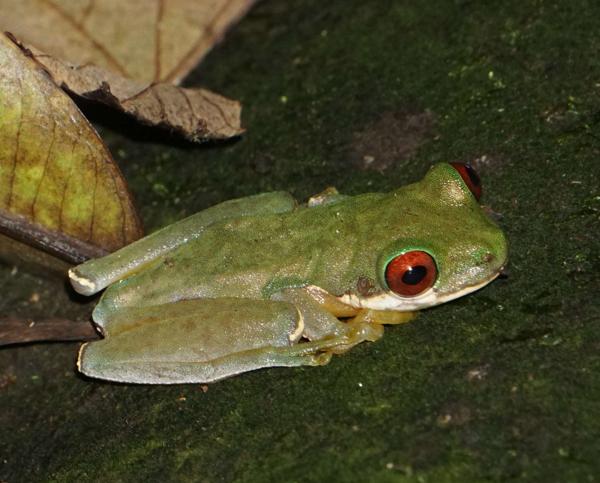
The adult male frog measures 25.1–28 mm in snout-vent length and the adult female frog about 34 mm. The skin of the dorsum is light or dark green in color and the skin of the ventrum is yellow. There is a white stripe on the face underneath the eye down the side of the body. There is a whitish spot above the groin. The inner thighs are light yellow in color. The iris is red.

This frog is endangered for several reasons, principally habitat loss. Logging for lumber, urbanization, droughts, and floods, all affect the population. It is preyed upon by both native and introduced predators. This frog is subject to damage from UV light and the fungal disease chytridiomycosis.

The scientific name of this frog, salvavida, means "lifesaver." The scientists named it after a Honduran beer called Salvavida. Wikipedia →

Global Distribution

Parks Where Found

# Park Country Daily sighting probability
1 Pico Bonito National Park 🇭🇳 Honduras
~40%

More parks will be added in future updates.

Before you go

What are the chances of seeing a Honduran Brook Frog in Pico Bonito National Park?

Likely

About 40% of wildlife watchers report a Honduran Brook Frog sighting in Pico Bonito National Park on a given day, based on 47 verified sightings from GBIF citizen-science data from 2019 to 2026. It is the 8th most-seen of the 11 amphibians we can rate there. Over three days the chance rises to about 70%, and over a week to over 90%, if each day is a fresh chance.

When is the best time to see a Honduran Brook Frog in Pico Bonito National Park?

June

In that month about 50% of wildlife watchers report a Honduran Brook Frog in Pico Bonito National Park on a given day, against under 5% in August and October, the lowest months.

What time of day is best to see a Honduran Brook Frog?

Between 10 pm and 1 am

Across all the parks we cover, that three-hour window holds the most Honduran Brook Frog sightings with a recorded time, and about 8 in 10 of them come between 6 pm and 6 am: it is mostly seen at night.

Where else can you see a Honduran Brook Frog?

Only Pico Bonito National Park, in our data

Pico Bonito National Park is the only park on Wallace's Line with enough records to rate Honduran Brook Frog sightings: about 40% of wildlife watchers there report one on a given day.

Which relatives of the Honduran Brook Frog live in Pico Bonito National Park?

Same family: Hylidae

The closest relatives of the Honduran Brook Frog that you can see in Pico Bonito National Park (family Hylidae, Hylid Tree Frogs) are Mexican Smilisca (about 60%), Yellow Treefrog (about 40%) and Ceiba Stream Frog (about 20%), with each one's daily chance of a sighting.

Where does the Honduran Brook Frog sighting chance come from?

GBIF citizen-science records

It is estimated from how often the Honduran Brook Frog is recorded against all the amphibians logged in Pico Bonito National Park (47 verified sightings from 2019 to 2026), calibrated against known sighting rates. Figures are rounded to the nearest 10% because citizen-science data supports honest approximations, not decimals, and months with records from fewer than five people show "—". How it works.

← Back to Pico Bonito National Park