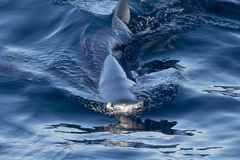
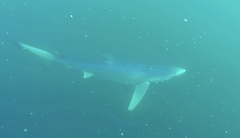
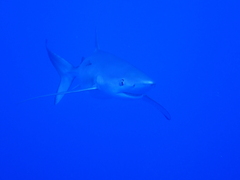
Blue Shark

Blue Shark

Prionace glauca

Silhouette: Ignacio Contreras · PhyloPic

Daily sighting probability ~70% · Very likely
at Pico Island Natural Park (Azores)

In 3 days >90%

11 Verified sightings at Pico Island Natural Park (Azores) From 2019 to 2026
11 In 1 park
July Best month
☀️ Diurnal When it's spotted

About the Blue Shark

The blue shark (Prionace glauca), also known as the great blue shark, is a species of requiem shark in the family Carcharhinidae which inhabits deep waters in the world's temperate and tropical oceans. It is the only living species of genus Prionace. An extinct species, P. clarki, is known from teeth from California of the Late Pliocene. Averaging around 3.1 m (10 ft) and preferring cooler waters, the blue shark migrates long distances, such as from New England to South America. It is listed as Near Threatened by the IUCN.

Although generally lethargic, they can move very quickly. Blue sharks are viviparous and are noted for large litters of 25 to over 100 pups. They feed primarily on small forage fish and squid, although they can take larger prey. Some of the blue shark's predators include the killer whale and larger sharks like the tiger shark and the great white shark. Their maximum lifespan is still unknown, but it is believed that they can live up to 20 years. They are one of the most abundant pelagic sharks, with large numbers being caught by fisheries as bycatch on longlines and nets.

The earliest fossil teeth of this species are known from the Miocene of Sri Lanka. Other fossil teeth of this species are known from the Miocene and Pliocene of Chile, Italy, and possibly Belgium.

Wikipedia →

Global Distribution

Parks Where Found

# Park Country Daily sighting probability
1 Pico Island Natural Park (Azores) 🇵🇹 Portugal
~70%

More parks will be added in future updates.

Before you go

What are the chances of seeing a Blue Shark in Pico Island Natural Park (Azores)?

Very likely

About 70% of wildlife watchers report a Blue Shark sighting in Pico Island Natural Park (Azores) on a given day, based on 11 verified sightings from GBIF citizen-science data from 2019 to 2026. Over three days the chance rises to over 90%, if each day is a fresh chance.

What time of day is best to see a Blue Shark?

Between 11 am and 2 pm

Across all the parks we cover, that three-hour window holds the most Blue Shark sightings with a recorded time, and about 9 in 10 of them come between 6 am and 6 pm: it is a daytime animal.

Where else can you see a Blue Shark?

Only Pico Island Natural Park (Azores), in our data

Pico Island Natural Park (Azores) is the only park on Wallace's Line with enough records to rate Blue Shark sightings: about 70% of wildlife watchers there report one on a given day.

Where does the Blue Shark sighting chance come from?

GBIF citizen-science records

It is estimated from how often the Blue Shark is recorded against all the sharks and rays logged in Pico Island Natural Park (Azores) (11 verified sightings from 2019 to 2026), calibrated against known sighting rates. Figures are rounded to the nearest 10% because citizen-science data supports honest approximations, not decimals, and months with records from fewer than five people show "—". How it works.

← Back to Pico Island Natural Park (Azores)