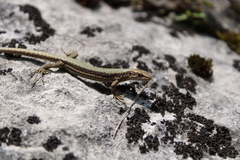
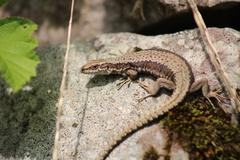
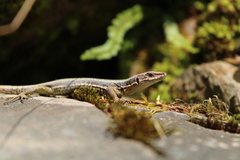
Horvath's Rock Lizard

Horvath's Rock Lizard

Iberolacerta horvathi

Silhouette: Gustav Mützel · PhyloPic

LCLeast ConcernNTVUENCR
Daily sighting probability ~30% · Possible
at Plitvice Lakes National Park

In 3 days ~70% in a week ~90%

10 Verified sightings at Plitvice Lakes National Park From 2019 to 2026
37 In all 2 parks
June Best month
☀️ Diurnal When it's spotted

About the Horvath's Rock Lizard

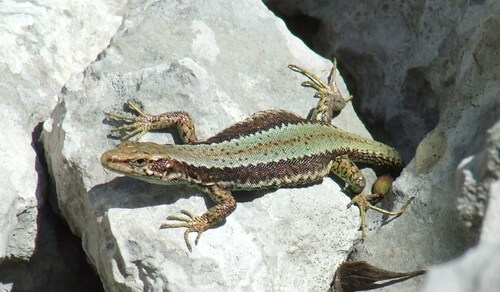
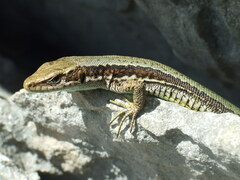
Horvath's rock lizard (Iberolacerta horvathi) is a species of lizard in the family Lacertidae. The species is endemic to Europe. Until 1997, this species had been assigned to the genus Lacerta, the same genus as the morphologically similar sand lizard (Lacerta agilis). The natural habitats of I. horvathi are temperate forests and shrublands, and rocky areas.

The specific name, horvathi is in honor of Hungarian entomologist Géza Horváth. The geographic range of I. horvathi in central and southern Europe, in mountainous areas of southern Austria, northeastern Italy, western Slovenia, and western Croatia, is fragmented, and believed to be a relict of a much larger range during the last ice age. The small, fragmented range of this species is the main cause of concern for the survival of this species, which is why it is given Near threatened status in the IUCN Red List and is also legally protected in the countries in which it lives.

Horvath's rock lizard grows to a snout-to-vent length (SVL) of 6.5 cm (2.6 in). It has a blunt snout and is dorso-ventrally flattened. The upper surface is pale greyish-brown contrasting sharply with... Wikipedia →
Global Distribution

Parks Where Found

# Park Country Daily sighting probability
1 Plitvice Lakes National Park 🇭🇷 Croatia
~30%
2 Triglav National Park 🇸🇮 Slovenia
~30%

Before you go

What are the chances of seeing a Horvath's Rock Lizard in Plitvice Lakes National Park?

Possible

About 30% of wildlife watchers report a Horvath's Rock Lizard sighting in Plitvice Lakes National Park on a given day, based on 10 verified sightings from GBIF citizen-science data from 2019 to 2026. It is the 7th most-seen of the 7 reptiles we can rate there. Over three days the chance rises to about 70%, and over a week to about 90%, if each day is a fresh chance.

When is the best time to see a Horvath's Rock Lizard in Plitvice Lakes National Park?

June

In that month about 60% of wildlife watchers report a Horvath's Rock Lizard in Plitvice Lakes National Park on a given day, against under 5% in April, the lowest month. November and December have too few records to rate.

What time of day is best to see a Horvath's Rock Lizard?

Between 10 am and 1 pm

Across all the parks we cover, that three-hour window holds the most Horvath's Rock Lizard sightings with a recorded time, and nearly all of them come between 6 am and 6 pm: it is a daytime animal.

Is Plitvice Lakes National Park the best place to see a Horvath's Rock Lizard?

Yes

Of the 2 parks where we can rate Horvath's Rock Lizard sightings, Plitvice Lakes National Park has the highest daily chance: about 30%. Next come Triglav National Park (Slovenia, about 30%).

Which relatives of the Horvath's Rock Lizard live in Plitvice Lakes National Park?

Same family: Lacertidae

The closest relatives of the Horvath's Rock Lizard that you can see in Plitvice Lakes National Park (family Lacertidae, Wall Lizards) are Green Lizard (about 70%) and Common Wall Lizard (about 40%), with each one's daily chance of a sighting.

Where does the Horvath's Rock Lizard sighting chance come from?

GBIF citizen-science records

It is estimated from how often the Horvath's Rock Lizard is recorded against all the reptiles logged in Plitvice Lakes National Park (10 verified sightings from 2019 to 2026), calibrated against known sighting rates. Figures are rounded to the nearest 10% because citizen-science data supports honest approximations, not decimals, and months with records from fewer than five people show "—". How it works.

← Back to Plitvice Lakes National Park