
Black-rumped Buttonquail

Black-rumped Buttonquail

Turnix nanus

Silhouette: PhyloPic

LCLeast ConcernNTVUENCR
Daily sighting probability <5% · Rare
at Queen Elizabeth National Park

In 3 days <5%

7 Verified sightings at Queen Elizabeth National Park From 2019 to 2026
7 In 1 park
June Best month
☀️ Diurnal When it's spotted

About the Black-rumped Buttonquail

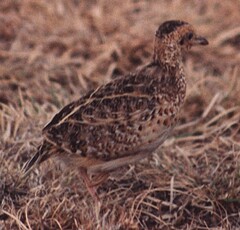
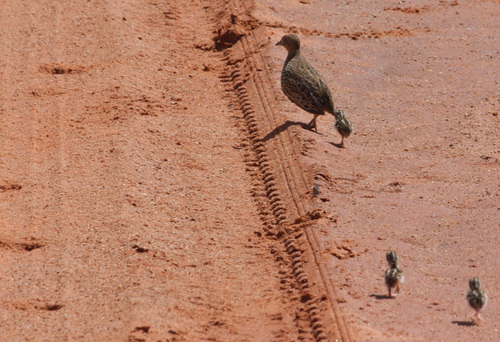
The black-rumped buttonquail (Turnix nanus) is a small species of bird in the buttonquail family. This species has a brown back, rufous chest, and pale belly, brown irises and a black rump. As usual for buttonquails but not for most birds, the female is larger and brighter than the male. The birds are shy and difficult to flush.

The species is found in open grassland through much of Africa outside the forested and more arid regions. It is resident in the central parts of the range but is a migratory breeder further north towards Lake Chad and the Central African Republic.

Madge and McGowan, Pheasants, Partridges and Grouse ISBN 0-7136-3966-0 Sinclair, Ian; Hockey, Phil; Tarboton, Warwick (2002). SASOL Birds of Southern Africa. Struik. ISBN 1-86872-721-1. Black-rumped buttonquail - Species text in The Atlas of Southern African Birds. Wikipedia →

Sounds

Call0:19

South Africa · 2026

© Marna Buys · XC1106611 · CC BY-NC-SA 4.0

Song0:14

South Africa · 2014

© Peter Boesman · XC280799 · CC BY-NC-ND 4.0

Global Distribution

Parks Where Found

# Park Country Daily sighting probability
1 Queen Elizabeth National Park 🇺🇬 Uganda
<5%

More parks will be added in future updates.

Before you go

What are the chances of seeing a Black-rumped Buttonquail in Queen Elizabeth National Park?

Rare

Under 5% of wildlife watchers report a Black-rumped Buttonquail sighting in Queen Elizabeth National Park on a given day, based on 7 verified sightings from GBIF citizen-science data from 2019 to 2026. It is the 387th most-seen of the 434 birds we can rate there. Over three days the chance rises to under 5%, if each day is a fresh chance.

When is the best time to see a Black-rumped Buttonquail in Queen Elizabeth National Park?

Any time of year

In every month with enough records, under 5% of wildlife watchers report a Black-rumped Buttonquail in Queen Elizabeth National Park on a given day, so our monthly data shows no clear season.

What time of day is best to see a Black-rumped Buttonquail?

Between 5 and 8 am

Across all the parks we cover, that three-hour window holds the most Black-rumped Buttonquail sightings with a recorded time, and about 9 in 10 of them come between 6 am and 6 pm: it is a daytime animal.

Where else can you see a Black-rumped Buttonquail?

Only Queen Elizabeth National Park, in our data

Queen Elizabeth National Park is the only park on Wallace's Line with enough records to rate Black-rumped Buttonquail sightings: under 5% of wildlife watchers there report one on a given day.

Where does the Black-rumped Buttonquail sighting chance come from?

GBIF citizen-science records

It is estimated from how often the Black-rumped Buttonquail is recorded against all the birds logged in Queen Elizabeth National Park (7 verified sightings from 2019 to 2026), calibrated against known sighting rates. Figures are rounded to the nearest 10% because citizen-science data supports honest approximations, not decimals, and months with records from fewer than five people show "—". How it works.

← Back to Queen Elizabeth National Park