
Vinaceous Dove

Vinaceous Dove

Streptopelia vinacea

Silhouette: Andy Wilson · PhyloPic

LCLeast ConcernNTVUENCR
Daily sighting probability <5% · Rare
at Queen Elizabeth National Park

In 3 days <5%

5 Verified sightings at Queen Elizabeth National Park From 2019 to 2026
1,056 In all 4 parks
August Best month
☀️ Diurnal When it's spotted

About the Vinaceous Dove

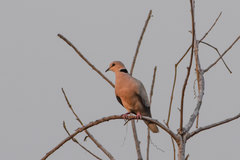
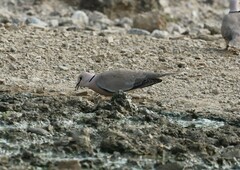
The vinaceous dove (Streptopelia vinacea) is a bird species in the pigeon family Columbidae that widely resident across northern Sub-Saharan Africa. The vinaceous dove was formally described in 1789 by German naturalist Johann Friedrich Gmelin in his revised and expanded edition of Carl Linnaeus's Systema Naturae. He placed it with all the other doves and pigeons in the genus Columba and coined the binomial name Columba vinacea. Gmelin based his description on the earlier publications by French ornithologists Mathurin Jacques Brisson and Georges-Louis Leclerc, Comte de Buffon. The vinaceous dove is now placed with 14 other species in the genus Streptopelia that was introduced in 1855 by French ornithologist Charles Lucien Bonaparte. The genus name is from the Ancient Greek στρεπτός (streptós) – literal meaning "twisted", but by extension, "wearing a torc" (i.e., twisted metal collar) – and πέλεια (péleia) meaning "wild dove". The specific vinacea is from Latin vinaceus, meaning "of wine" or "vinaceous". The species is monotypic; no subspecies are recognized.

The vinaceous dove is a small, stocky pigeon, typically 26 to 30 centimeters (10.2 to 11.8 inches... Wikipedia →

Sounds

Song0:43

Ghana · 2022

© Peter Boesman · XC719502 · CC BY-NC-ND 4.0

Song0:49

Guinea-Bissau · 2020

© Joost van Bruggen · XC523606 · CC BY-NC-ND 4.0

Song0:16

Senegal · 2016

© Bram Piot · XC317284 · CC BY-NC-SA 4.0

Global Distribution

Parks Where Found

# Park Country Daily sighting probability
1 Niokolo-Koba National Park 🇸🇳 Senegal
~70%
2 Kidepo Valley National Park 🇺🇬 Uganda
~60%
3 Murchison Falls National Park 🇺🇬 Uganda
~30%
4 Queen Elizabeth National Park 🇺🇬 Uganda
<5%

Cities Where Found

# City Country Daily sighting probability
1 Ouagadougou 🇧🇫 Burkina Faso
~60%
2 Serrekunda 🇬🇲 Gambia
~60%
3 Maiduguri 🇳🇬 Nigeria
~10%
4 Accra 🇬🇭 Ghana
~10%
5 Abuja 🇳🇬 Nigeria
~10%
6 N'Djamena 🇹🇩 Chad
~10%
7 Lomé 🇹🇬 Togo
~10%

Before you go

What are the chances of seeing a Vinaceous Dove in Queen Elizabeth National Park?

Rare

Under 5% of wildlife watchers report a Vinaceous Dove sighting in Queen Elizabeth National Park on a given day, based on 5 verified sightings from GBIF citizen-science data from 2019 to 2026. It is the 418th most-seen of the 434 birds we can rate there. Over three days the chance rises to under 5%, if each day is a fresh chance.

When is the best time to see a Vinaceous Dove in Queen Elizabeth National Park?

Any time of year

In every month with enough records, under 5% of wildlife watchers report a Vinaceous Dove in Queen Elizabeth National Park on a given day, so our monthly data shows no clear season.

What time of day is best to see a Vinaceous Dove?

Between 9 am and noon

Across all the parks we cover, that three-hour window holds the most Vinaceous Dove sightings with a recorded time, and about 7 in 10 of them come between 6 am and 6 pm: it is a daytime animal.

Which relatives of the Vinaceous Dove live in Queen Elizabeth National Park?

Same genus: Streptopelia

The closest relatives of the Vinaceous Dove that you can see in Queen Elizabeth National Park (genus Streptopelia, Turtle-Doves and Collared-Doves) are Cape Turtle Dove (about 60%), Red-eyed Dove (about 40%) and African Mourning Dove (about 20%), with each one's daily chance of a sighting.

Where does the Vinaceous Dove sighting chance come from?

GBIF citizen-science records

It is estimated from how often the Vinaceous Dove is recorded against all the birds logged in Queen Elizabeth National Park (5 verified sightings from 2019 to 2026), calibrated against known sighting rates. Figures are rounded to the nearest 10% because citizen-science data supports honest approximations, not decimals, and months with records from fewer than five people show "—". How it works.

← Back to Queen Elizabeth National Park