Fire-tailed Sunbird

Fire-tailed Sunbird

Aethopyga ignicauda

Silhouette: Rachael Joakim · PhyloPic

LCLeast ConcernNTVUENCR
Daily sighting probability <5% · Rare
at Royal Manas National Park

In 3 days <5% in a week ~10%

10 Verified sightings at Royal Manas National Park From 2019 to 2026
103 In all 2 parks
March Best month
☀️ Diurnal When it's spotted

About the Fire-tailed Sunbird

The fire-tailed sunbird (Aethopyga ignicauda) is a species of sunbird in the family Nectariniidae. It is found in the northern parts of the Indian subcontinent, primarily in the Himalayas, and also in some adjoining regions in Southeast Asia. The species occurs in Bangladesh, Bhutan, India, Myanmar, Nepal, Thailand and Tibet.

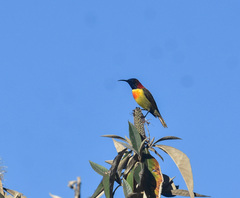
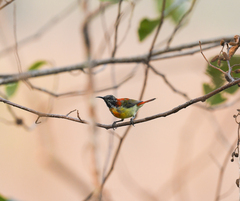
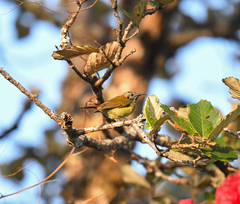
Its natural habitats are temperate forests and subtropical or tropical moist montane forests. Breeding males have a scarlet nape and mantle, and a yellow-orange breast and an olive-green belly. They develop a long scarlet tail, and including the tail are about 15 cm long; females are about two-thirds that length. Females have a grey-olive head and throat, and a yellow belly. Females are differentiated from the similar female green-tailed sunbird by a straighter bill, squarer tail (lacking white tips and with trace of brownish orange on the sides) and mor noticeable olive-yellow on the rump. Eclipse males are similar to females but have brighter yellow bellies, scarlet uppertail coverts, and scarlet tail sides. They live in conifer forests at altitudes up to 4,000 meters, descending into the valleys during the cold season, wintering in broadleaved forests. They eat insects, and also nectar. They breed in rhododendron shrub. Both parents take part in feeding the young. Wikipedia →

Sounds

Call0:12

Myanmar · 2019

© Thet Zaw Naing · XC946666 · CC BY-NC-SA 4.0

Song0:44

Myanmar · 2020

© Agris Celmins · XC687958 · CC BY-NC-ND 4.0

Song0:55

Nepal · 1990

© Scott Connop · XC581786 · CC BY-NC-SA 4.0

Global Distribution

Parks Where Found

# Park Country Daily sighting probability
1 Langtang National Park 🇳🇵 Nepal
~20%
2 Royal Manas National Park 🇧🇹 Bhutan
<5%

Cities Where Found

# City Country Daily sighting probability
1 Kathmandu 🇳🇵 Nepal
<5%
2 Dehradun 🇮🇳 India
<5%

Before you go

What are the chances of seeing a Fire-tailed Sunbird in Royal Manas National Park?

Rare

Under 5% of wildlife watchers report a Fire-tailed Sunbird sighting in Royal Manas National Park on a given day, based on 10 verified sightings from GBIF citizen-science data from 2019 to 2026. It is the 339th most-seen of the 388 birds we can rate there. Over three days the chance rises to under 5%, and over a week to about 10%, if each day is a fresh chance.

When is the best time to see a Fire-tailed Sunbird in Royal Manas National Park?

March

In that month about 10% of wildlife watchers report a Fire-tailed Sunbird in Royal Manas National Park on a given day, against under 5% in April–July and October–February, the lowest months. That is one of Royal Manas National Park's driest months, with about 120 mm of rain against 930 mm in July. August and September have too few records to rate.

What time of day is best to see a Fire-tailed Sunbird?

Between 7 and 10 am

Across all the parks we cover, that three-hour window holds the most Fire-tailed Sunbird sightings with a recorded time, and about 9 in 10 of them come between 6 am and 6 pm: it is a daytime animal.

Is Royal Manas National Park the best place to see a Fire-tailed Sunbird?

2nd of 2

Of the 2 parks where we can rate Fire-tailed Sunbird sightings, Royal Manas National Park ranks 2nd at under 5%. The best odds are in Langtang National Park (Nepal, about 20%).

Which relatives of the Fire-tailed Sunbird live in Royal Manas National Park?

Same genus: Aethopyga

The closest relatives of the Fire-tailed Sunbird that you can see in Royal Manas National Park (genus Aethopyga, Red Sunbirds and Allies) are Black-throated Sunbird (about 30%), Crimson Sunbird (about 30%) and Green-tailed Sunbird (about 10%), with each one's daily chance of a sighting.

Where does the Fire-tailed Sunbird sighting chance come from?

GBIF citizen-science records

It is estimated from how often the Fire-tailed Sunbird is recorded against all the birds logged in Royal Manas National Park (10 verified sightings from 2019 to 2026), calibrated against known sighting rates. Figures are rounded to the nearest 10% because citizen-science data supports honest approximations, not decimals, and months with records from fewer than five people show "—". How it works.

← Back to Royal Manas National Park