Antelope Jackrabbit

Antelope Jackrabbit

Lepus alleni

Silhouette: Jan A. Venter, Herbert H. T. Prins, David A. Balfour & Rob Slotow (vectorized by T. Michael Keesey) · PhyloPic

LCLeast ConcernNTVUENCR
Daily sighting probability ~10% · With luck
at Saguaro National Park

In 3 days ~20% in a week ~50%

28 Verified sightings at Saguaro National Park From 2019 to 2026
28 In 1 park
January Best month
🌅 Crepuscular When it's spotted

About the Antelope Jackrabbit

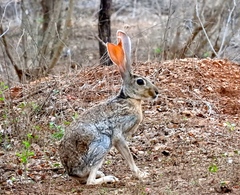
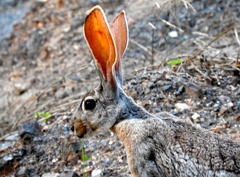
The antelope jackrabbit (Lepus alleni), also known as Allen's hare, is a species of North American hare in the family Leporidae found in southern Arizona and northwestern Mexico. Considered the "handsomest" of the hares, it occupies dry desert areas and was one of the last of the North American mammals to be formally described.

The antelope jackrabbit was first described in 1890 by American naturalist Edgar Alexander Mearns, who named it "Allen's hare" (Lepus alleni) after Joel Asaph Allen, curator of mammals and birds at the American Museum of Natural History and the originator of Allen's rule.

Fossil evidence places the genus Lepus as having first appeared in North America approximately 2.5 million years ago. A now extinct jackrabbit species, Lepus giganteus, was thought to exist in North America during this time. This species shared similar physical traits with the antelope jackrabbit, making it difficult to differentiate fossils of the two species. In a 2014 study, researchers hypothesized that L. giganteus served as a common ancestor to the antelope jackrabbit and black... Wikipedia →

Global Distribution

Parks Where Found

# Park Country Daily sighting probability
1 Saguaro National Park 🇺🇸 United States
~10%

More parks will be added in future updates.

Zoos & Centres Where Found

# Zoo / Centre Country
1 Arizona-Sonora Desert Museum 🇺🇸 United States In captivity

Before you go

What are the chances of seeing an Antelope Jackrabbit in Saguaro National Park?

With luck

About 10% of wildlife watchers report an Antelope Jackrabbit sighting in Saguaro National Park on a given day, based on 28 verified sightings from GBIF citizen-science data from 2019 to 2026. It is the 14th most-seen of the 24 mammals we can rate there. Over three days the chance rises to about 20%, and over a week to about 50%, if each day is a fresh chance.

When is the best time to see an Antelope Jackrabbit in Saguaro National Park?

January

In that month about 20% of wildlife watchers report an Antelope Jackrabbit in Saguaro National Park on a given day, against under 5% in April and June, the lowest months. That is one of Saguaro National Park's wettest months, with about 50 mm of rain against almost none in May.

What time of day is best to see an Antelope Jackrabbit?

Between 6 and 9 am

Across all the parks we cover, that three-hour window holds the most Antelope Jackrabbit sightings with a recorded time, and about 7 in 10 of them come between 6 am and 6 pm: it is most active around dawn and dusk.

Where else can you see an Antelope Jackrabbit?

Only Saguaro National Park, in our data

Saguaro National Park is the only park on Wallace's Line with enough records to rate Antelope Jackrabbit sightings: about 10% of wildlife watchers there report one on a given day.

Where does the Antelope Jackrabbit sighting chance come from?

GBIF citizen-science records

It is estimated from how often the Antelope Jackrabbit is recorded against all the mammals logged in Saguaro National Park (28 verified sightings from 2019 to 2026), calibrated against known sighting rates. Figures are rounded to the nearest 10% because citizen-science data supports honest approximations, not decimals, and months with records from fewer than five people show "—". How it works.

← Back to Saguaro National Park