Gilded Flicker

Gilded Flicker

Colaptes chrysoides

Silhouette: FJDegrange · PhyloPic

LCLeast ConcernNTVUENCR
Daily sighting probability ~30% · Possible
at Saguaro National Park

In 3 days ~60% in a week ~90%

2,552 Verified sightings at Saguaro National Park From 2019 to 2026
2,802 In all 4 parks
August Best month
☀️ Diurnal When it's spotted

About the Gilded Flicker

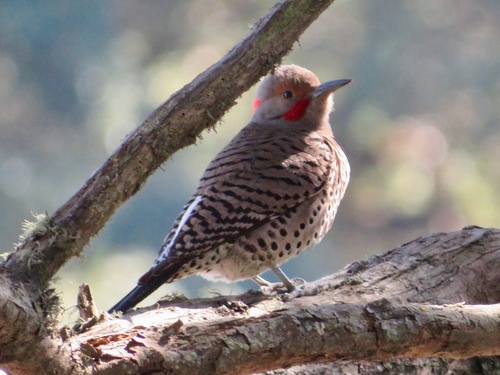
The gilded flicker (Colaptes chrysoides) is a large woodpecker (mean length of 29 cm (11 in)) of the Sonoran, Yuma, and eastern Colorado Desert regions of the Southwestern United States and northwestern Mexico, including all of the Baja California peninsula except the extreme northwestern region. Yellow underwings distinguish the gilded flicker from the northern flicker (Colaptes auratus) found within the same region, which has red underwings.

Four subspecies are recognized: The Cape gilded flicker (C. c. chrysoides) resides in southern Baja California. The brown gilded flicker (C. c. brunnescens) resides in northern and central Baja California. Mearns' gilded flicker (C. c. mearnsi) resides in extreme southeastern California to Arizona and northwestern Mexico.

The Mexican gilded flicker (C. c. tenebrosus) resides in northwestern Mexico from northern Sonora to northern Sinaloa. The gilded flicker most frequently builds its nest hole in a saguaro (Carnegiea gigantea), excavating a nest hole nearer to the top than to the ground. Less frequently, they will also nest in desert dry washes with Frémont's cottonwood (Populus fremontii) or willows (Salix sp.).... Wikipedia →

Sounds

Call0:34

United States · 2017

© Pat Goltz · XC1157431 · CC BY-NC-SA 4.0

Alarm call0:10

Mexico · 2023

© Sue Riffe · XC785640 · CC BY-NC-SA 4.0

Song0:40

United States · 2021

© Scott Crabtree · XC622425 · CC BY-NC-SA 4.0

Global Distribution

Parks Where Found

# Park Country Daily sighting probability
1 Cabo Pulmo National Park 🇲🇽 Mexico
~30%
2 Saguaro National Park 🇺🇸 United States
~30%
3 Bahía de Loreto National Park 🇲🇽 Mexico
~20%
4 El Vizcaíno Biosphere Reserve 🇲🇽 Mexico
<5%

Cities Where Found

# City Country Daily sighting probability
1 Phoenix 🇺🇸 United States
~30%
2 Mesa 🇺🇸 United States
<5%
3 Salt Lake City 🇺🇸 United States
<5%

Zoos & Centres Where Found

# Zoo / Centre Country
1 Arizona-Sonora Desert Museum 🇺🇸 United States In captivity

Before you go

What are the chances of seeing a Gilded Flicker in Saguaro National Park?

Possible

About 30% of wildlife watchers report a Gilded Flicker sighting in Saguaro National Park on a given day, based on 2,552 verified sightings from GBIF citizen-science data from 2019 to 2026. It is the 22nd most-seen of the 220 birds we can rate there. Over three days the chance rises to about 60%, and over a week to about 90%, if each day is a fresh chance.

When is the best time to see a Gilded Flicker in Saguaro National Park?

August

In that month about 40% of wildlife watchers report a Gilded Flicker in Saguaro National Park on a given day, against about 20% in January, June and September–November, the lowest months. That is one of Saguaro National Park's wettest months, with about 45 mm of rain against almost none in May.

What time of day is best to see a Gilded Flicker?

Between 6 and 9 am

Across all the parks we cover, that three-hour window holds the most Gilded Flicker sightings with a recorded time, and about 8 in 10 of them come between 6 am and 6 pm: it is a daytime animal.

Is Saguaro National Park the best place to see a Gilded Flicker?

Among the best

Of the 4 parks where we can rate Gilded Flicker sightings, Saguaro National Park ranks 2nd at about 30%, level with the leaders once rounded. The best odds are in Cabo Pulmo National Park (Mexico, about 30%).

Where does the Gilded Flicker sighting chance come from?

GBIF citizen-science records

It is estimated from how often the Gilded Flicker is recorded against all the birds logged in Saguaro National Park (2,552 verified sightings from 2019 to 2026), calibrated against known sighting rates. Figures are rounded to the nearest 10% because citizen-science data supports honest approximations, not decimals, and months with records from fewer than five people show "—". How it works.

← Back to Saguaro National Park