Tiger Rattlesnake

Tiger Rattlesnake

Crotalus tigris

Silhouette: Bill Bouton (source photo) & T. Michael Keesey (vectorization) · PhyloPic

LCLeast ConcernNTVUENCR
Daily sighting probability ~20% · Possible
at Saguaro National Park

In 3 days ~40% in a week ~70%

76 Verified sightings at Saguaro National Park From 2019 to 2026
76 In 1 park
August Best month
🌙 Nocturnal When it's spotted

About the Tiger Rattlesnake

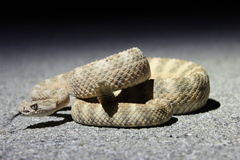
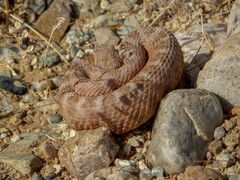
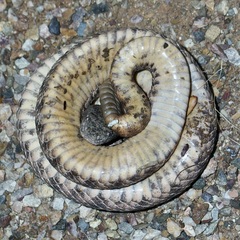
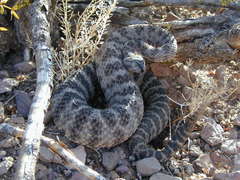
The tiger rattlesnake (Crotalus tigris) is a highly venomous pit viper species found in the southwestern United States and northwestern Mexico. No subspecies are currently recognized. The specific name tigris, (Latin for 'tiger'), refers to the many narrow dorsal crossbands, which create a pattern of vertical stripes when viewed from the side.

American herpetologist Robert Kennicott described the tiger rattlesnake in 1859. Common names include tiger rattlesnake and tiger rattler. The tiger rattlesnake is easily identified by its small, spade-shaped head, which is about 1/25 of its total body length. It has the smallest head of any rattlesnake, and a large rattle. The color pattern consists of a gray, lavender, blue-gray, pink, or buff ground color that usually turns to pink, pale orange, or cream on the sides. Tiger rattlesnakes are the only rattlesnake with crossbands on the anterior portion of their bodies, with a series of 35 to 52 gray, olive, or brown bands across the dorsum consisting mainly of heavy punctations. These crossbands have vague borders and are wider dorsally than laterally. Also mid-dorsally, the crossbands become wider than the spaces... Wikipedia →

Global Distribution

Parks Where Found

# Park Country Daily sighting probability
1 Saguaro National Park 🇺🇸 United States
~20%

More parks will be added in future updates.

Cities Where Found

# City Country Daily sighting probability
1 Mesa 🇺🇸 United States
<5%
2 Phoenix 🇺🇸 United States
<5%

Zoos & Centres Where Found

# Zoo / Centre Country
1 Ecological Center of Sonora 🇲🇽 Mexico In captivity
2 Omaha’s Henry Doorly Zoo and Aquarium 🇺🇸 United States In captivity
3 Phoenix Zoo 🇺🇸 United States In captivity
4 Arizona-Sonora Desert Museum 🇺🇸 United States In captivity
5 Chattanooga Zoo at Warner Park 🇺🇸 United States In captivity
6 Universeum 🇸🇪 Sweden In captivity

Before you go

What are the chances of seeing a Tiger Rattlesnake in Saguaro National Park?

Possible

About 20% of wildlife watchers report a Tiger Rattlesnake sighting in Saguaro National Park on a given day, based on 76 verified sightings from GBIF citizen-science data from 2019 to 2026. It is the 20th most-seen of the 51 reptiles we can rate there. Over three days the chance rises to about 40%, and over a week to about 70%, if each day is a fresh chance.

When is the best time to see a Tiger Rattlesnake in Saguaro National Park?

July and August

In those months about 30% of wildlife watchers report a Tiger Rattlesnake in Saguaro National Park on a given day, against under 5% in December and January, the lowest months. Those are among Saguaro National Park's wettest months, with about 50 mm of rain a month against almost none in May.

What time of day is best to see a Tiger Rattlesnake?

Between 7 and 10 pm

Across all the parks we cover, that three-hour window holds the most Tiger Rattlesnake sightings with a recorded time, and about 8 in 10 of them come between 6 pm and 6 am: it is mostly seen at night.

Where else can you see a Tiger Rattlesnake?

Only Saguaro National Park, in our data

Saguaro National Park is the only park on Wallace's Line with enough records to rate Tiger Rattlesnake sightings: about 20% of wildlife watchers there report one on a given day.

Where does the Tiger Rattlesnake sighting chance come from?

GBIF citizen-science records

It is estimated from how often the Tiger Rattlesnake is recorded against all the reptiles logged in Saguaro National Park (76 verified sightings from 2019 to 2026), calibrated against known sighting rates. Figures are rounded to the nearest 10% because citizen-science data supports honest approximations, not decimals, and months with records from fewer than five people show "—". How it works.

← Back to Saguaro National Park