
Acacia Tit

Acacia Tit

Parus thruppi

Silhouette: Ferran Sayol · PhyloPic

Daily sighting probability ~20% · Possible
at Samburu National Reserve

In 3 days ~40% in a week ~70%

178 Verified sightings at Samburu National Reserve From 2019 to 2026
256 In all 3 parks
August Best month
☀️ Diurnal When it's spotted

About the Acacia Tit

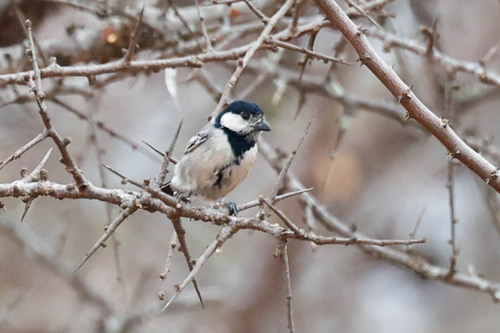
The acacia tit (Melaniparus thruppi), also known as the Somali tit and northern grey tit, is a species of bird in the family Paridae. It is native to north eastern Africa where it occurs in dry acacia habitat. The smallest of the grey Melaniparus tits of Africa, the acacia tit has a glossy blue-black cap, nape, throat and breast contrasting with a large buffy white patch which extends from the bill to the sides of the neck. There is a broad black band which stretches from the breast to the vent. The upperparts are grey with white panels in the wings and there is a white spot on the nape. The underparts are greyish white, broken by the black band. Legs and bill are slate grey. The females tend to have a narrower band than males. Juveniles are similar to the adults but are duller. It measures 11.5–12 cm (4.5–4.7 in) in length and weighs 12 g (0.42 oz).

The acacia tit is found from Ethiopia and Somalia south to north eastern Tanzania. The acacia tit inhabits arid and semi arid wooded and bushed savanna, principally in acacia and stands of trees along streams or rivers, avoiding truly arid regions. It is recorded up to 2,000 m (6,600 ft)... Wikipedia →

Global Distribution

Parks Where Found

# Park Country Daily sighting probability
1 Samburu National Reserve 🇰🇪 Kenya
~20%
2 Tsavo West National Park 🇰🇪 Kenya
~10%
3 Tsavo East National Park 🇰🇪 Kenya
<5%

Before you go

What are the chances of seeing an Acacia Tit in Samburu National Reserve?

Possible

About 20% of wildlife watchers report an Acacia Tit sighting in Samburu National Reserve on a given day, based on 178 verified sightings from GBIF citizen-science data from 2019 to 2026. It is the 105th most-seen of the 341 birds we can rate there. Over three days the chance rises to about 40%, and over a week to about 70%, if each day is a fresh chance.

When is the best time to see an Acacia Tit in Samburu National Reserve?

August and November

In those months about 30% of wildlife watchers report an Acacia Tit in Samburu National Reserve on a given day, against under 5% in January, the lowest month. Those are among Samburu National Reserve's wettest months, with about 50 mm of rain a month against 5 mm in September.

What time of day is best to see an Acacia Tit?

Between 8 and 11 am

Across all the parks we cover, that three-hour window holds the most Acacia Tit sightings with a recorded time, and about 8 in 10 of them come between 6 am and 6 pm: it is a daytime animal.

Is Samburu National Reserve the best place to see an Acacia Tit?

Yes

Of the 3 parks where we can rate Acacia Tit sightings, Samburu National Reserve has the highest daily chance: about 20%. Next come Tsavo West National Park (Kenya, about 10%) and Tsavo East National Park (Kenya, under 5%).

Where does the Acacia Tit sighting chance come from?

GBIF citizen-science records

It is estimated from how often the Acacia Tit is recorded against all the birds logged in Samburu National Reserve (178 verified sightings from 2019 to 2026), calibrated against known sighting rates. Figures are rounded to the nearest 10% because citizen-science data supports honest approximations, not decimals, and months with records from fewer than five people show "—". How it works.

← Back to Samburu National Reserve