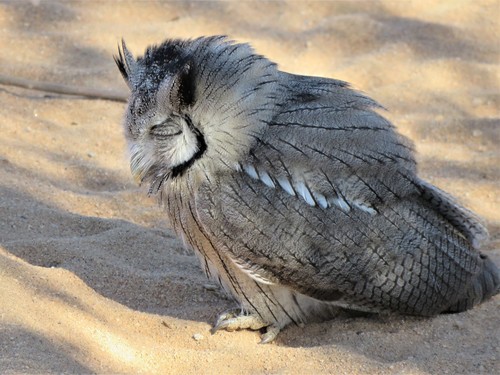
Grayish Eagle-Owl

Grayish Eagle-Owl

Bubo cinerascens

Silhouette: Steven Traver · PhyloPic

LCLeast ConcernNTVUENCR
Daily sighting probability <5% · Rare
at Samburu National Reserve

In 3 days <5%

5 Verified sightings at Samburu National Reserve From 2019 to 2026
75 In all 3 parks
December Best month
🌅 Crepuscular When it's spotted

About the Grayish Eagle-Owl

The greyish eagle-owl or vermiculated eagle-owl (Bubo cinerascens) is a rather large owl of the northern part of sub-Saharan Africa. It was previously regarded as the northern subspecies of the spotted eagle-owl (Bubo africanus).

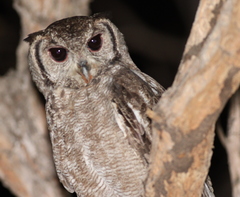
This species is about 43 cm (17 in) long and weighs about 500 g (18 oz). Like the spotted eagle-owl, the greyish eagle-owl has mottled dark brown, buff, and white upperparts and finely barred (vermiculated) underparts giving a greyish-brown appearance. It differs from the spotted eagle-owl in having dark brown (not yellow) eyes and a brownish facial disk marked with a heavy brown circle around each eye. It also has morphological differences, such as being lighter though about the same length and having shorter tarsi.

As the greyish eagle-owl was considered the northern form of the spotted eagle-owl until recently their vocalisations have not been well studied. The call of the male recorded in West Africa consisted of two clear syllables and has been rendered as "koo-whoo" where the "koo" part is rather explosive and the "whoo" is somewhat downward inflected, lower pitched and extended. This call is made every few seconds and is... Wikipedia →

Sounds

Duet0:13

Senegal · 2025

© Azens · XC1059809 · CC BY-NC-SA 4.0

Call0:51

Senegal · 2024

© Frank Lambert · XC1041321 · CC BY-NC-ND 4.0

Song0:51

Ghana · 2022

© Peter Boesman · XC718897 · CC BY-NC-ND 4.0

Global Distribution

Parks Where Found

# Park Country Daily sighting probability
1 Murchison Falls National Park 🇺🇬 Uganda
<5%
2 Kidepo Valley National Park 🇺🇬 Uganda
<5%
3 Samburu National Reserve 🇰🇪 Kenya
<5%

Cities Where Found

# City Country Daily sighting probability
1 Serrekunda 🇬🇲 Gambia
<5%

Zoos & Centres Where Found

# Zoo / Centre Country
1 Espace Rambouillet 🇫🇷 France In captivity
2 Kano Zoo 🇳🇬 Nigeria In captivity
3 Small Breeds Farm Park 🇬🇧 United Kingdom In captivity
4 Audu Bako Zoo 🇳🇬 Nigeria In captivity
5 International Centre for Birds of Prey 🇬🇧 United Kingdom In captivity
6 Le centre de soins des rapaces Espace Rambouillet 🇫🇷 France In captivity

Before you go

What are the chances of seeing a Grayish Eagle-Owl in Samburu National Reserve?

Rare

Under 5% of wildlife watchers report a Grayish Eagle-Owl sighting in Samburu National Reserve on a given day, based on 5 verified sightings from GBIF citizen-science data from 2019 to 2026. It is the 333rd most-seen of the 341 birds we can rate there. Over three days the chance rises to under 5%, if each day is a fresh chance.

When is the best time to see a Grayish Eagle-Owl in Samburu National Reserve?

December

In that month about 10% of wildlife watchers report a Grayish Eagle-Owl in Samburu National Reserve on a given day, against under 5% in January to November, the lowest months.

What time of day is best to see a Grayish Eagle-Owl?

Between 5 and 8 pm

Across all the parks we cover, that three-hour window holds the most Grayish Eagle-Owl sightings with a recorded time, and about 6 in 10 of them come between 6 am and 6 pm: it is most active around dawn and dusk.

Is Samburu National Reserve the best place to see a Grayish Eagle-Owl?

Among the best

Of the 3 parks where we can rate Grayish Eagle-Owl sightings, Samburu National Reserve ranks 3rd at under 5%, level with the leaders once rounded. The best odds are in Murchison Falls National Park (Uganda, under 5%) and Kidepo Valley National Park (Uganda, under 5%).

Where does the Grayish Eagle-Owl sighting chance come from?

GBIF citizen-science records

It is estimated from how often the Grayish Eagle-Owl is recorded against all the birds logged in Samburu National Reserve (5 verified sightings from 2019 to 2026), calibrated against known sighting rates. Figures are rounded to the nearest 10% because citizen-science data supports honest approximations, not decimals, and months with records from fewer than five people show "—". How it works.

← Back to Samburu National Reserve