
Magpie Starling

Magpie Starling

Speculipastor bicolor

Silhouette: Rafael Maia · PhyloPic

LCLeast ConcernNTVUENCR
Daily sighting probability ~10% · With luck
at Samburu National Reserve

In 3 days ~20% in a week ~30%

59 Verified sightings at Samburu National Reserve From 2019 to 2026
111 In all 2 parks
September Best month
☀️ Diurnal When it's spotted

About the Magpie Starling

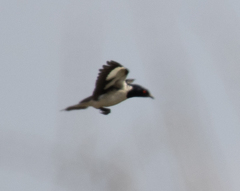
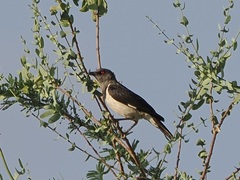
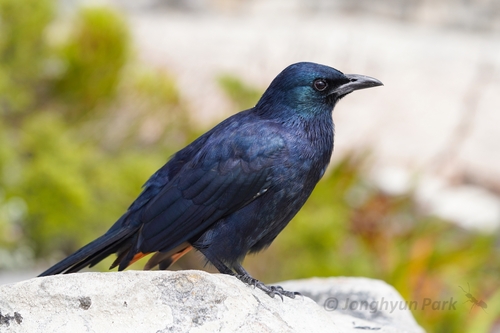
The magpie starling (Speculipastor bicolor) is a member of the starling family from eastern Africa. The magpie starling is about 16–19 cm (6.5–7.5 in) in length. The white patches at base of primaries are obvious in flight. The male is a shiny blue-black on upperparts, head and upper breast, with mostly white below and bloodred eyes. The female is a dull blackish above with dark grey crown, and a dark grey throat is separated from white belly by a glossy black breast band. Her eyes are red or orange-red. The Juvenile is brown with a white belly; eyes brown, becoming orange-red in as the bird matures. Exceptional young birds are entirely white below, including chin and throat.

The call is a prolonged soft babbling quereeeh quaaa kereek quak-quak, suaaaa, cherak-chik-chak...mixed higher harsh notes. It is a gregarious nomadic pied starling of dry brush and thorn-scrub in northern and eastern Kenya. It is also found in Ethiopia, Somalia, South Sudan, Tanzania, and Uganda. Dale A. Zimmerman, Birds of Kenya and Northern Tanzania, Princeton University Press, 1999

Image at ADW Wikipedia →

Sounds

Call0:21

Ethiopia · 2015

© Hans Matheve · XC306036 · CC BY-NC-ND 4.0

Song1:19

Ethiopia · 2015

© Andrew Spencer · XC210031 · CC BY-NC-SA 4.0

Call0:26

Kenya · 2024

© Peter Boesman · XC948472 · CC BY-NC-ND 4.0

Global Distribution

Parks Where Found

# Park Country Daily sighting probability
1 Samburu National Reserve 🇰🇪 Kenya
~10%
2 Tsavo East National Park 🇰🇪 Kenya
~10%

Before you go

What are the chances of seeing a Magpie Starling in Samburu National Reserve?

With luck

About 10% of wildlife watchers report a Magpie Starling sighting in Samburu National Reserve on a given day, based on 59 verified sightings from GBIF citizen-science data from 2019 to 2026. It is the 185th most-seen of the 341 birds we can rate there. Over three days the chance rises to about 20%, and over a week to about 30%, if each day is a fresh chance.

When is the best time to see a Magpie Starling in Samburu National Reserve?

January, June and September–November

In those months about 10% of wildlife watchers report a Magpie Starling in Samburu National Reserve on a given day, against under 5% in February–May, July–August and December, the lowest months.

What time of day is best to see a Magpie Starling?

Between 3 and 6 pm

Across all the parks we cover, that three-hour window holds the most Magpie Starling sightings with a recorded time, and about 8 in 10 of them come between 6 am and 6 pm: it is a daytime animal.

Is Samburu National Reserve the best place to see a Magpie Starling?

Yes

Of the 2 parks where we can rate Magpie Starling sightings, Samburu National Reserve has the highest daily chance: about 10%. Next come Tsavo East National Park (Kenya, about 10%).

Which relatives of the Magpie Starling live in Samburu National Reserve?

Same family: Sturnidae

The closest relatives of the Magpie Starling that you can see in Samburu National Reserve (family Sturnidae, Starlings) are Superb Starling (about 80%), Wattled Starling (about 40%) and Golden-breasted Starling (about 30%), with each one's daily chance of a sighting.

Where does the Magpie Starling sighting chance come from?

GBIF citizen-science records

It is estimated from how often the Magpie Starling is recorded against all the birds logged in Samburu National Reserve (59 verified sightings from 2019 to 2026), calibrated against known sighting rates. Figures are rounded to the nearest 10% because citizen-science data supports honest approximations, not decimals, and months with records from fewer than five people show "—". How it works.

← Back to Samburu National Reserve