
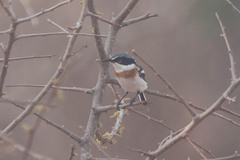

Pygmy Batis

Pygmy Batis

Batis perkeo

Silhouette: Mathieu Pélissié · PhyloPic

LCLeast ConcernNTVUENCR
Daily sighting probability ~30% · Possible
at Samburu National Reserve

In 3 days ~60% in a week ~90%

268 Verified sightings at Samburu National Reserve From 2019 to 2026
605 In all 6 parks
October Best month
☀️ Diurnal When it's spotted

About the Pygmy Batis

The pygmy batis (Batis perkeo) is a very small insectivorous bird which finds its food foraging among leaves, it is a member of the wattle-eyes family, the Platysteiridae. It occurs in the dry savannahs of north-eastern Africa.

The pygmy batis, as its name suggests, is a tiny, rather dumpy but dapper black, white and grey bird with similarities to the flycatchers. The male has a bluish-grey head and back with a contrasting black face mask and short white supercilium above the yellow eye. The rump and lower back are spotted with white and the rump feathers are relatively long giving a fluffy appearance. It has black wings which have a broad white strip formed by the broad white edges to feathers of the median and greater coverts, and the inner secondaries and tertials. The tail is black but the outer tail feathers have white edges and tips. The underparts are white, broken with a narrow black breast band. The females are similar to the males but have a pale rufous-buff breast band and chin and the face mask, supercilium and wing stripe are buffy brown. The bill and legs are black. The pygmy batis has a body length of 8–9 cm (3.1–3.5 in) and a weight of 5–9 g (0.18–0... Wikipedia →

Sounds

Song0:18

Tanzania · 2026

© isaac kilusu · XC1142018 · CC BY-NC-SA 4.0

Call0:14

Ethiopia · 2015

© Hans Matheve · XC306646 · CC BY-NC-ND 4.0

Song0:39

Kenya · 2018

© Frank Lambert · XC451454 · CC BY-NC-ND 4.0

Global Distribution

Parks Where Found

# Park Country Daily sighting probability
1 Tsavo West National Park 🇰🇪 Kenya
~30%
2 Samburu National Reserve 🇰🇪 Kenya
~30%
3 Tsavo East National Park 🇰🇪 Kenya
~10%
4 Kidepo Valley National Park 🇺🇬 Uganda
~10%
5 Mkomazi National Park 🇹🇿 Tanzania
~10%
6 Amboseli National Park 🇰🇪 Kenya
<5%

Before you go

What are the chances of seeing a Pygmy Batis in Samburu National Reserve?

Possible

About 30% of wildlife watchers report a Pygmy Batis sighting in Samburu National Reserve on a given day, based on 268 verified sightings from GBIF citizen-science data from 2019 to 2026. It is the 82nd most-seen of the 341 birds we can rate there. Over three days the chance rises to about 60%, and over a week to about 90%, if each day is a fresh chance.

When is the best time to see a Pygmy Batis in Samburu National Reserve?

April, August and October

In those months about 40% of wildlife watchers report a Pygmy Batis in Samburu National Reserve on a given day, against about 10% in March, May and December–January, the lowest months. Those are among Samburu National Reserve's wettest months, with about 50 mm of rain a month against 5 mm in September.

What time of day is best to see a Pygmy Batis?

Between 7 and 10 am

Across all the parks we cover, that three-hour window holds the most Pygmy Batis sightings with a recorded time, and about 8 in 10 of them come between 6 am and 6 pm: it is a daytime animal.

Is Samburu National Reserve the best place to see a Pygmy Batis?

Among the best

Of the 6 parks where we can rate Pygmy Batis sightings, Samburu National Reserve ranks 2nd at about 30%, level with the leaders once rounded. The best odds are in Tsavo West National Park (Kenya, about 30%).

Where does the Pygmy Batis sighting chance come from?

GBIF citizen-science records

It is estimated from how often the Pygmy Batis is recorded against all the birds logged in Samburu National Reserve (268 verified sightings from 2019 to 2026), calibrated against known sighting rates. Figures are rounded to the nearest 10% because citizen-science data supports honest approximations, not decimals, and months with records from fewer than five people show "—". How it works.

← Back to Samburu National Reserve