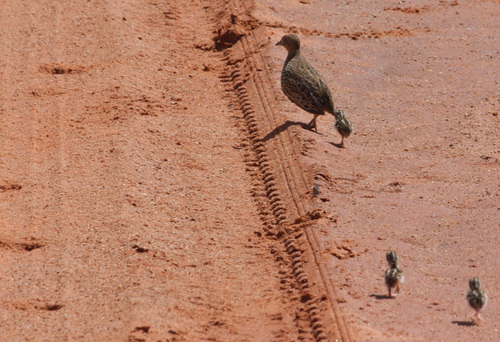
Somali Courser

Somali Courser

Cursorius somalensis

Silhouette: Sheatherius · PhyloPic

LCLeast ConcernNTVUENCR
Daily sighting probability ~20% · Possible
at Samburu National Reserve

In 3 days ~40% in a week ~70%

156 Verified sightings at Samburu National Reserve From 2019 to 2026
345 In all 2 parks
January Best month
☀️ Diurnal When it's spotted

About the Somali Courser

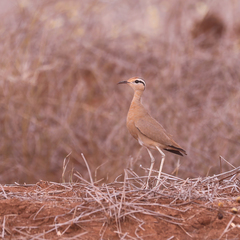
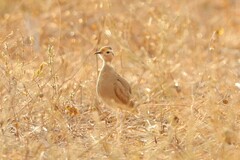
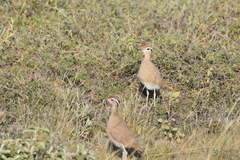
The Somali courser (Cursorius somalensis) is a wader in the pratincole and courser family Glareolidae, native to eastern Africa in Eritrea, eastern Ethiopia, Somalia, extreme southeast South Sudan, and northern and eastern Kenya. It is unusual among waders in being a bird of open dry country, preferably semi-desert, short grasslands, and burnt grass, where it typically hunts its insect prey by running on the ground.

It is 19–22 cm long, very similar to cream-coloured courser in most characteristics, but differing from it in having a darker, more greyish-brown body colour, and most obviously when in flight, in having only the outer half of the wing black underneath (the whole underwing is black in cream-coloured courser); the inner underwing being the same sandy-brown as the body. Like cream-coloured courser, it has a black stripe and white eyebrow behind its eyes, which when seen from behind look like a "V".

Acceptance as a distinct species is relatively... Wikipedia →

Sounds

Flight call0:04

Somalia · 2014

© Bram Piot · XC172816 · CC BY-NC-SA 4.0

Global Distribution

Parks Where Found

# Park Country Daily sighting probability
1 Tsavo East National Park 🇰🇪 Kenya
~20%
2 Samburu National Reserve 🇰🇪 Kenya
~20%

Before you go

What are the chances of seeing a Somali Courser in Samburu National Reserve?

Possible

About 20% of wildlife watchers report a Somali Courser sighting in Samburu National Reserve on a given day, based on 156 verified sightings from GBIF citizen-science data from 2019 to 2026. It is the 119th most-seen of the 341 birds we can rate there. Over three days the chance rises to about 40%, and over a week to about 70%, if each day is a fresh chance.

When is the best time to see a Somali Courser in Samburu National Reserve?

January–April, June and October–November

In those months about 20% of wildlife watchers report a Somali Courser in Samburu National Reserve on a given day, against about 10% in May, July–September and December, the lowest months.

What time of day is best to see a Somali Courser?

Between 4 and 7 pm

Across all the parks we cover, that three-hour window holds the most Somali Courser sightings with a recorded time, and about 8 in 10 of them come between 6 am and 6 pm: it is a daytime animal.

Is Samburu National Reserve the best place to see a Somali Courser?

Among the best

Of the 2 parks where we can rate Somali Courser sightings, Samburu National Reserve ranks 2nd at about 20%, level with the leaders once rounded. The best odds are in Tsavo East National Park (Kenya, about 20%).

Where does the Somali Courser sighting chance come from?

GBIF citizen-science records

It is estimated from how often the Somali Courser is recorded against all the birds logged in Samburu National Reserve (156 verified sightings from 2019 to 2026), calibrated against known sighting rates. Figures are rounded to the nearest 10% because citizen-science data supports honest approximations, not decimals, and months with records from fewer than five people show "—". How it works.

← Back to Samburu National Reserve