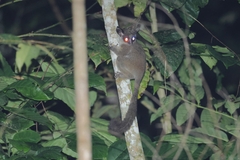
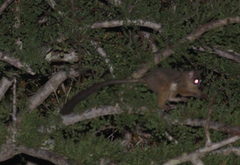
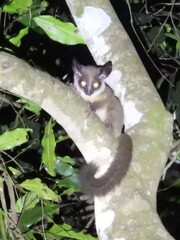
Northern Lesser Galago

Northern Lesser Galago

Galago senegalensis

Silhouette: Kai Caspar · PhyloPic

LCLeast ConcernNTVUENCR
Daily sighting probability ~10% · With luck
at Serengeti National Park

In 3 days ~20% in a week ~40%

6 Verified sightings at Serengeti National Park From 2019 to 2026
14 In all 2 parks
April Best month
🌙 Nocturnal When it's spotted

About the Northern Lesser Galago

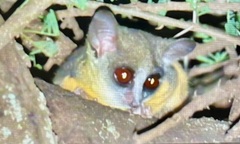
The Senegal bushbaby (Galago senegalensis), also known as the Senegal galago, the lesser galago or the lesser bush baby, is a small, nocturnal primate, a member of the galago family Galagidae. The name "bush baby" may come either from the animals' cries or from their appearance. They are agile leapers, and run swiftly along branches. They live in Africa south of the Sahara and nearby islands, including Zanzibar. They tend to live in dry woodland regions and savannah regions. They are small primates (130 mm and 95–300 grams) with woolly thick fur that ranges from silvery grey to dark brown. They have large eyes, giving them good night vision; strong hind limbs; and long tails, which help them balance. Their ears are made up of four segments that can bend back individually, to aid their hearing when hunting insects at night. Their omnivorous diet is a mixture of other small animals, including birds and insects, fruit, seeds, flowers, eggs, nuts, and tree gums.

Bushbabies reproduce twice a year, at the beginning of the rains (November) and the end (February). They are polygynous, and the females raise their young in nests made from leaves. They have 1–2 babies per litter, with gestation period being 110–120 days. Bush babies are born with half-closed eyes, unable to move about independently. After a few days, the mother carries the infant in her mouth, and leaves it on convenient branches while feeding.

Adult females maintain territories, but share them with their offspring. Males leave their mothers' territories after puberty, but females remain, forming social groups consisting of closely related females and their immature young. Adult males maintain separate territories, which overlap with those of the female social groups; generally, one adult male mates with all the females in an area. Males who have not established such territories sometimes form small bachelor groups.

Bush babies communicate both by calling to each other and by marking their paths with their urine. At the end of the night, group members use a special rallying call and gather to sleep in a nest made of leaves, in a group of branches, or in a hole in a tree. Wikipedia →

Sounds

Recording0:41

Kenya · 2025

© Yvonne A. de Jong · iNaturalist · CC BY-NC-SA 4.0

Global Distribution

Parks Where Found

# Park Country Daily sighting probability
1 Masai Mara National Reserve 🇰🇪 Kenya
~10%
2 Serengeti National Park 🇹🇿 Tanzania
~10%

Zoos & Centres Where Found

# Zoo / Centre Country
1 Prague Zoo 🇨🇿 Czechia In captivity
2 Dvůr Králové Zoo 🇨🇿 Czechia In captivity
3 Zoo Pilsen 🇨🇿 Czechia In captivity
4 Berlin Zoological Garden 🇩🇪 Germany In captivity
5 Dierenpark Hoenderdaell 🇳🇱 Netherlands In captivity
6 Chiba Zoological Park 🇯🇵 Japan In captivity
7 Krakow Zoo 🇵🇱 Poland In captivity
8 Faunia 🇪🇸 Spain In captivity
9 Tennōji Zoo 🇯🇵 Japan In captivity
10 Ueno Zoological Gardens (West Garden) 🇯🇵 Japan In captivity
11 Randers Tropical Zoo 🇩🇰 Denmark In captivity
12 Aquarium Berlin 🇩🇪 Germany In captivity
13 Rákosův pavilon 🇨🇿 Czechia In captivity
14 Velemlokárium 🇨🇿 Czechia In captivity
15 Landgoed Hoenderdaell 🇳🇱 Netherlands In captivity

Before you go

What are the chances of seeing a Northern Lesser Galago in Serengeti National Park?

With luck

About 10% of wildlife watchers report a Northern Lesser Galago sighting in Serengeti National Park on a given day, based on 6 verified sightings from GBIF citizen-science data from 2019 to 2026. It is the 40th most-seen of the 41 mammals we can rate there. Over three days the chance rises to about 20%, and over a week to about 40%, if each day is a fresh chance.

When is the best time to see a Northern Lesser Galago in Serengeti National Park?

April

In that month about 20% of wildlife watchers report a Northern Lesser Galago in Serengeti National Park on a given day, against under 5% in January–February, May–August and November, the lowest months. That is one of Serengeti National Park's wettest months, with about 140 mm of rain against 5 mm in July.

What time of day is best to see a Northern Lesser Galago?

Between 7 and 10 pm

Across all the parks we cover, that three-hour window holds the most Northern Lesser Galago sightings with a recorded time, and about 7 in 10 of them come between 6 pm and 6 am: it is mostly seen at night.

Is Serengeti National Park the best place to see a Northern Lesser Galago?

Among the best

Of the 2 parks where we can rate Northern Lesser Galago sightings, Serengeti National Park ranks 2nd at about 10%, level with the leaders once rounded. The best odds are in Masai Mara National Reserve (Kenya, about 10%).

Which relatives of the Northern Lesser Galago live in Serengeti National Park?

Same order: Primates

The closest relatives of the Northern Lesser Galago that you can see in Serengeti National Park (order Primates) are Olive Baboon (about 40%) and Vervet Monkey (about 40%), with each one's daily chance of a sighting.

Where does the Northern Lesser Galago sighting chance come from?

GBIF citizen-science records

It is estimated from how often the Northern Lesser Galago is recorded against all the mammals logged in Serengeti National Park (6 verified sightings from 2019 to 2026), calibrated against known sighting rates. Figures are rounded to the nearest 10% because citizen-science data supports honest approximations, not decimals, and months with records from fewer than five people show "—". How it works.

← Back to Serengeti National Park