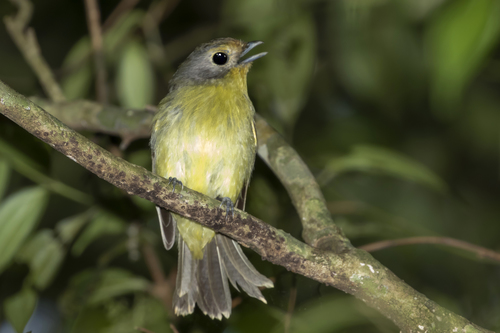
Guianan Cock-of-the-rock

Guianan Cock-of-the-rock

Rupicola rupicola

Silhouette: Gargominy O. · PhyloPic

LCLeast ConcernNTVUENCR
Daily sighting probability ~10% · With luck
at Sierra de la Macarena National Park

In 3 days ~30% in a week ~50%

135 Verified sightings at Sierra de la Macarena National Park From 2019 to 2026
135 In 1 park
May Best month
☀️ Diurnal When it's spotted

About the Guianan Cock-of-the-rock

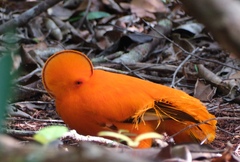
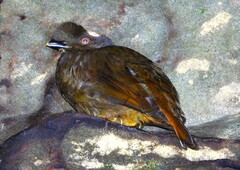
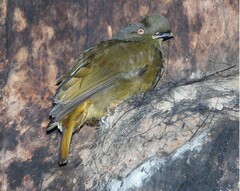
The Guianan cock-of-the-rock (Rupicola rupicola) is a species of cotinga, a passerine bird from South America. It is about 30 cm (12 in) in length and weighs about 200 to 220 g (7.1 to 7.8 oz). It is found in tropical rainforests, near its preferred habitat of rocky outcrops. The female's plumage is brownish/dark smokey grey in colour, and generally less noticeable than the males because of their nesting work in rocky areas. The male's feathers are a bright orange. Both have a heavy body, broad-based bill and wear a remarkable half-moon crest on the head. It is one of two species of the genus Rupicola, the other being the Andean cock-of-the-rock. The Guianan cock-of-the-rock lives across the forested region of northeastern South America. Its diet consists mostly of fruit, but they sometimes feast on small snakes and lizards.

The Guianan cock-of-the-rock breeds in the early months of the year and, on average, the female lays her eggs around March. The females choose a mate by flying down to the ground and pecking the male on his rump. The male then turns around and the mating takes place almost immediately. During the height of the mating season, males engage in competitive displays in the lek, which is a complex courting behaviour that is done to attract females. Males and females live separately except when the females choose a mate. The mating success varies based on multiple factors, ranging from the plumage exhibited by a male to the composition of the lek itself. There is speculation that the male–male competition is an important factor in lek formation and breeding. The main predators of the Guianan cock-of-the-rock are harpy eagles and black-and-white hawk-eagles. Wikipedia →

Sounds

Call0:52

French Guiana · 2022

© Geoffrey Monchaux · XC764461 · CC BY-NC-SA 4.0

Canto0:50

Brazil · 2018

© Caio Brito · XC556560 · CC BY-NC-SA 4.0

Song0:18

Brazil · 2019

© JAYRSON ARAUJO DE OLIVEIRA · XC494144 · CC BY-NC-SA 4.0

Global Distribution

Parks Where Found

# Park Country Daily sighting probability
1 Sierra de la Macarena National Park 🇨🇴 Colombia
~10%

More parks will be added in future updates.

Zoos & Centres Where Found

# Zoo / Centre Country
1 San Diego Zoo 🇺🇸 United States In captivity
2 Walsrode World Bird Park 🇩🇪 Germany In captivity
3 Bird Paradise 🇸🇬 Singapore In captivity
4 Rainforest Wild Asia 🇸🇬 Singapore In captivity
5 Vogelpark Avifauna 🇳🇱 Netherlands In captivity
6 Aviario Nacional de Colombia 🇨🇴 Colombia In captivity
7 Zoológico do CIGS 🇧🇷 Brazil In captivity
8 Dallas World Aquarium 🇺🇸 United States In captivity

Before you go

What are the chances of seeing a Guianan Cock-of-the-rock in Sierra de la Macarena National Park?

With luck

About 10% of wildlife watchers report a Guianan Cock-of-the-rock sighting in Sierra de la Macarena National Park on a given day, based on 135 verified sightings from GBIF citizen-science data from 2019 to 2026. It is the 110th most-seen of the 418 birds we can rate there. Over three days the chance rises to about 30%, and over a week to about 50%, if each day is a fresh chance.

When is the best time to see a Guianan Cock-of-the-rock in Sierra de la Macarena National Park?

May and September

In those months about 20% of wildlife watchers report a Guianan Cock-of-the-rock in Sierra de la Macarena National Park on a given day, against under 5% in January and March–April, the lowest months.

What time of day is best to see a Guianan Cock-of-the-rock?

Between 9 am and noon

Across all the parks we cover, that three-hour window holds the most Guianan Cock-of-the-rock sightings with a recorded time, and about 9 in 10 of them come between 6 am and 6 pm: it is a daytime animal.

Where else can you see a Guianan Cock-of-the-rock?

Only Sierra de la Macarena National Park, in our data

Sierra de la Macarena National Park is the only park on Wallace's Line with enough records to rate Guianan Cock-of-the-rock sightings: about 10% of wildlife watchers there report one on a given day.

Where does the Guianan Cock-of-the-rock sighting chance come from?

GBIF citizen-science records

It is estimated from how often the Guianan Cock-of-the-rock is recorded against all the birds logged in Sierra de la Macarena National Park (135 verified sightings from 2019 to 2026), calibrated against known sighting rates. Figures are rounded to the nearest 10% because citizen-science data supports honest approximations, not decimals, and months with records from fewer than five people show "—". How it works.

← Back to Sierra de la Macarena National Park