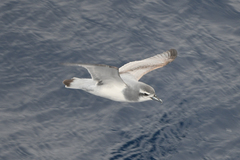
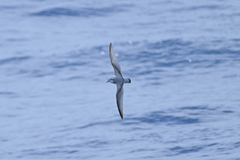
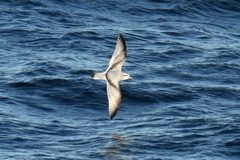
Antarctic Prion

Antarctic Prion

Pachyptila desolata

Silhouette: Alexandre Vong · PhyloPic

LCLeast ConcernNTVUENCR
Daily sighting probability ~40% · Likely
at South Georgia and the South Sandwich Islands

In 3 days ~80% in a week >90%

341 Verified sightings at South Georgia and the South Sandwich Islands From 2019 to 2026
519 In all 3 parks
December Best month
☀️ Diurnal When it's spotted

About the Antarctic Prion

The Antarctic prion (Pachyptila desolata) also known as the dove prion, or totorore in Māori, is the largest of the prions, a genus of small petrels of the Southern Ocean. The Antarctic prion was formally described in 1789 by the German naturalist Johann Friedrich Gmelin in his revised and expanded edition of Carl Linnaeus's Systema Naturae. He placed it with the other petrels in the genus Procellaria and coined the binomial name Procellaria desolata. Gmelin based his description on the "brown-banded petrel" that had been described in 1785 by the English ornithologist John Latham from a specimen supplied by the naturalist Joseph Banks that had been collected on the "Isle of Desolation", now the Kerguelen Islands. The Antarctic prion is now one of seven prions placed in the genus Pachyptila that was introduced in 1811 by the German zoologist Johann Karl Wilhelm Illiger. The genus name combines the Ancient Greek pakhus meaning "dense" or "thick" with ptilon meaning "feather" or "plumage". The specific epithet desolata is from Latin desolatus meaning "forsaken" or "desolated". The species is monotypic: no subspecies are recognised.

Prions are members of the family Procellariidae...

Wikipedia →

Sounds

Uncertain1:26

France · 2020

© Hichem MACHOUK · XC622658 · CC BY-NC-SA 4.0

Song0:09

France · 2020

© Émile Brisson-Curadeau · XC555374 · CC BY-NC-SA 4.0

Global Distribution

Parks Where Found

# Park Country Daily sighting probability
1 South Georgia and the South Sandwich Islands 🇬🇸 South Georgia and the South Sandwich Islands
~40%
2 Antarctic Peninsula & South Shetland Islands 🇦🇶 Antarctica
~10%
3 Table Mountain National Park 🇿🇦 South Africa
<5%

Before you go

What are the chances of seeing an Antarctic Prion in South Georgia and the South Sandwich Islands?

Likely

About 40% of wildlife watchers report an Antarctic Prion sighting in South Georgia and the South Sandwich Islands on a given day, based on 341 verified sightings from GBIF citizen-science data from 2019 to 2026. It is the 18th most-seen of the 37 birds we can rate there. Over three days the chance rises to about 80%, and over a week to over 90%, if each day is a fresh chance.

When is the best time to see an Antarctic Prion in South Georgia and the South Sandwich Islands?

February and December

In those months about 50% of wildlife watchers report an Antarctic Prion in South Georgia and the South Sandwich Islands on a given day, against about 20% in June and September, the lowest months. July and August have too few records to rate.

What time of day is best to see an Antarctic Prion?

Between 2 and 5 pm

Across all the parks we cover, that three-hour window holds the most Antarctic Prion sightings with a recorded time, and about 9 in 10 of them come between 6 am and 6 pm: it is a daytime animal.

Is South Georgia and the South Sandwich Islands the best place to see an Antarctic Prion?

Yes

Of the 3 parks where we can rate Antarctic Prion sightings, South Georgia and the South Sandwich Islands has the highest daily chance: about 40%. Next come Antarctic Peninsula & South Shetland Islands (Antarctica, about 10%) and Table Mountain National Park (South Africa, under 5%).

Where does the Antarctic Prion sighting chance come from?

GBIF citizen-science records

It is estimated from how often the Antarctic Prion is recorded against all the birds logged in South Georgia and the South Sandwich Islands (341 verified sightings from 2019 to 2026), calibrated against known sighting rates. Figures are rounded to the nearest 10% because citizen-science data supports honest approximations, not decimals, and months with records from fewer than five people show "—". How it works.

← Back to South Georgia and the South Sandwich Islands