Northern Giant Petrel

Northern Giant Petrel

Macronectes halli

Silhouette: Alexandre Vong · PhyloPic

LCLeast ConcernNTVUENCR
Daily sighting probability ~80% · Very likely
at South Georgia and the South Sandwich Islands

In 3 days >90%

923 Verified sightings at South Georgia and the South Sandwich Islands From 2019 to 2026
1,492 In all 11 parks
March Best month
☀️ Diurnal When it's spotted

About the Northern Giant Petrel

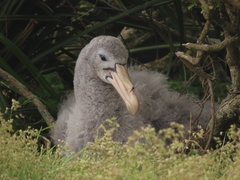
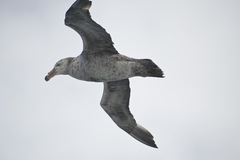
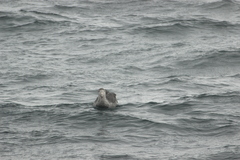
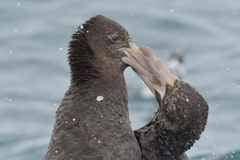
The northern giant petrel (Macronectes halli), also known as Hall's giant petrel, is a large, predatory seabird of the southern oceans. Its range overlaps broadly with the range of the related southern giant petrel (Macronectes giganteus), albeit slightly further to the north.

The northern giant petrel was formally described in 1912 by the Australian born ornithologist Gregory Mathews as a subspecies of the southern giant petrel with the trinomial name Macronectes giganteus halli. The specific epithet halli was chosen to honour the Australian ornithologist Robert Hall who had described the birds breeding on the Kerguelen Islands. The northern giant petrel is now considered to be a separate species and has the binomial name Macronectes halli. It is monotypic: no subspecies are recognised. The genus name combines the Ancient Greek makros meaning "great" and nēktēs meaning "swimmer". The name "petrel" refers to the Biblical account of Saint Peter walking on water, referring to the way these birds run on top of the water as they are getting airborne.

The two giant petrel species make up the genus Macronectes. They belong to the order Procellariiformes, the tube-nosed seabirds...

Wikipedia →

Sounds

Alarm call1:30

New Zealand · 2017

© David Boyle · XC927079 · CC BY-NC-SA 4.0

Call0:26

France · 2020

© Hichem MACHOUK · XC623852 · CC BY-NC-SA 4.0

Call1:06

United Kingdom · 2015

© Andrew Spencer · XC254065 · CC BY-NC-SA 4.0

Global Distribution

Parks Where Found

# Park Country Daily sighting probability
1 South Georgia and the South Sandwich Islands 🇬🇸 South Georgia and the South Sandwich Islands
~80%
2 Península Valdés 🇦🇷 Argentina
~20%
3 Antarctic Peninsula & South Shetland Islands 🇦🇶 Antarctica
~10%
4 Falkland Islands 🇫🇰 Falkland Islands
~10%
5 Rakiura National Park 🇳🇿 New Zealand
<5%
6 Tierra del Fuego National Park 🇦🇷 Argentina
<5%
7 Fiordland National Park 🇳🇿 New Zealand
<5%
8 Table Mountain National Park 🇿🇦 South Africa
<5%
9 Phillip Island Nature Park 🇦🇺 Australia
<5%
10 West Coast National Park 🇿🇦 South Africa
<5%
11 Royal National Park 🇦🇺 Australia
<5%

Cities Where Found

# City Country Daily sighting probability
1 Montevideo 🇺🇾 Uruguay
<5%
2 Sydney 🇦🇺 Australia
<5%

Zoos & Centres Where Found

# Zoo / Centre Country
1 Willowbank Wildlife Reserve 🇳🇿 New Zealand In captivity

Before you go

What are the chances of seeing a Northern Giant Petrel in South Georgia and the South Sandwich Islands?

Very likely

About 80% of wildlife watchers report a Northern Giant Petrel sighting in South Georgia and the South Sandwich Islands on a given day, based on 923 verified sightings from GBIF citizen-science data from 2019 to 2026. It is the 8th most-seen of the 37 birds we can rate there. Over three days the chance rises to over 90%, if each day is a fresh chance.

When is the best time to see a Northern Giant Petrel in South Georgia and the South Sandwich Islands?

March

In that month about 90% of wildlife watchers report a Northern Giant Petrel in South Georgia and the South Sandwich Islands on a given day, against about 50% in June, the lowest month. July and August have too few records to rate.

What time of day is best to see a Northern Giant Petrel?

Between 9 am and noon

Across all the parks we cover, that three-hour window holds the most Northern Giant Petrel sightings with a recorded time, and about 9 in 10 of them come between 6 am and 6 pm: it is a daytime animal.

Is South Georgia and the South Sandwich Islands the best place to see a Northern Giant Petrel?

Yes

Of the 11 parks where we can rate Northern Giant Petrel sightings, South Georgia and the South Sandwich Islands has the highest daily chance: about 80%. Next come Península Valdés (Argentina, about 20%) and Antarctic Peninsula & South Shetland Islands (Antarctica, about 10%).

Where does the Northern Giant Petrel sighting chance come from?

GBIF citizen-science records

It is estimated from how often the Northern Giant Petrel is recorded against all the birds logged in South Georgia and the South Sandwich Islands (923 verified sightings from 2019 to 2026), calibrated against known sighting rates. Figures are rounded to the nearest 10% because citizen-science data supports honest approximations, not decimals, and months with records from fewer than five people show "—". How it works.

← Back to South Georgia and the South Sandwich Islands