Double-Banded Carpenter Bee

Double-Banded Carpenter Bee

Xylocopa caffra

Daily sighting probability ~10% · With luck
at Table Mountain National Park

In 3 days ~40% in a week ~70%

249 Verified sightings at Table Mountain National Park From 2019 to 2026
326 In all 5 parks
January Best month
☀️ Diurnal When it's spotted

About the Double-Banded Carpenter Bee

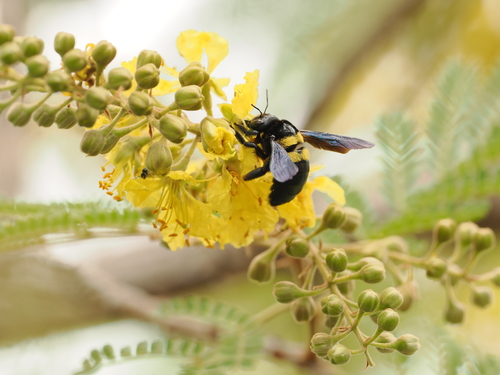
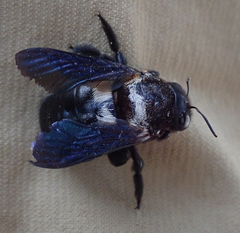
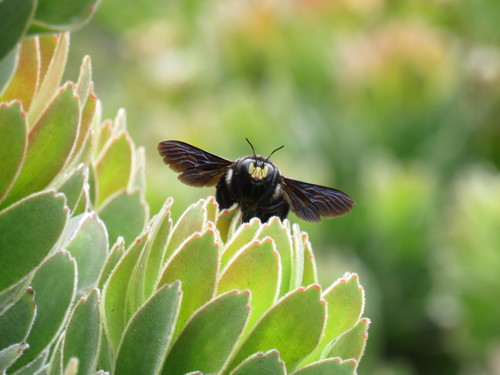
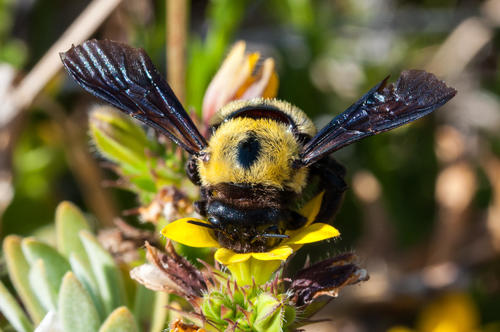
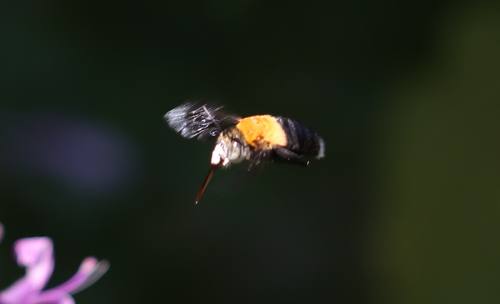
Xylocopa caffra is a species of Afrotropical carpenter bee that ranges from west to central and southern Africa, besides Madagascar and some Indian Ocean archipelagos. The females are black with two white or yellow bands over the hind thorax and first abdominal segment respectively, while the males are uniform greenish yellow in colour. Females with white bands are associated with dry climatic conditions during larval development, but females of either colour, or colour grade, may emerge from the same brood. In the Western Cape all have yellow bands however. A form with orange-red bands occurs in East Africa.

The species is at home in various habitat types, from moist coastal settings to dry savannah. The territorial males patrol small areas around particular plants or flowers. The females are solitary nesters in Aloe or Agave stems, tree branches or timber. The nests are partitioned into various cells, separated by walls of glued wood residue. A wide variety of plants are used as sources of nectar and pollen.

As with other carpenter bees, the larvae are fed a mixture of pollen and nectar. The females have a mutualistic association with phoretic mites... Wikipedia →

Global Distribution

Parks Where Found

# Park Country Daily sighting probability
1 Table Mountain National Park 🇿🇦 South Africa
~10%
2 Namib-Naukluft National Park 🇳🇦 Namibia
~10%
3 Addo Elephant National Park 🇿🇦 South Africa
~10%
4 Kruger National Park 🇿🇦 South Africa
~10%
5 Garden Route National Park 🇿🇦 South Africa
~10%

Cities Where Found

# City Country Daily sighting probability
1 Addis Ababa 🇪🇹 Ethiopia
~20%
2 Johannesburg 🇿🇦 South Africa
~20%
3 Pretoria 🇿🇦 South Africa
~20%
4 Cape Town 🇿🇦 South Africa
~10%
5 Nairobi 🇰🇪 Kenya
~10%
6 Durban 🇿🇦 South Africa
~10%

Before you go

What are the chances of seeing a Double-Banded Carpenter Bee in Table Mountain National Park?

With luck

About 10% of wildlife watchers report a Double-Banded Carpenter Bee sighting in Table Mountain National Park on a given day, based on 249 verified sightings from GBIF citizen-science data from 2019 to 2026. It is the 15th most-seen of the 344 insects we can rate there. Over three days the chance rises to about 40%, and over a week to about 70%, if each day is a fresh chance.

When is the best time to see a Double-Banded Carpenter Bee in Table Mountain National Park?

January and September

In those months about 20% of wildlife watchers report a Double-Banded Carpenter Bee in Table Mountain National Park on a given day, against about 10% in February–August and October–December, the lowest months.

What time of day is best to see a Double-Banded Carpenter Bee?

Between 10 am and 1 pm

Across all the parks we cover, that three-hour window holds the most Double-Banded Carpenter Bee sightings with a recorded time, and about 9 in 10 of them come between 6 am and 6 pm: it is a daytime animal.

Is Table Mountain National Park the best place to see a Double-Banded Carpenter Bee?

Yes

Of the 5 parks where we can rate Double-Banded Carpenter Bee sightings, Table Mountain National Park has the highest daily chance: about 10%. Next come Namib-Naukluft National Park (Namibia, about 10%) and Addo Elephant National Park (South Africa, about 10%).

Where does the Double-Banded Carpenter Bee sighting chance come from?

GBIF citizen-science records

It is estimated from how often the Double-Banded Carpenter Bee is recorded against all the insects logged in Table Mountain National Park (249 verified sightings from 2019 to 2026), calibrated against known sighting rates. Figures are rounded to the nearest 10% because citizen-science data supports honest approximations, not decimals, and months with records from fewer than five people show "—". How it works.

← Back to Table Mountain National Park