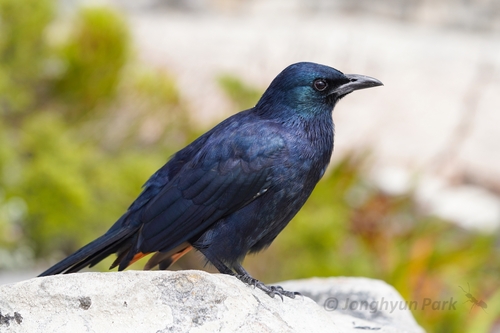
Striped Flufftail

Striped Flufftail

Sarothrura affinis

Silhouette: Andrew Smith (original) · PhyloPic

LCLeast ConcernNTVUENCR
Daily sighting probability <5% · Rare
at Table Mountain National Park

In 3 days <5%

31 Verified sightings at Table Mountain National Park From 2019 to 2026
44 In all 3 parks
September Best month
☀️🌙 Day & Night When it's spotted

About the Striped Flufftail

The striped flufftail (Sarothrura affinis) is a species of bird in the flufftail family Sarothruridae. It is also known as the red-tailed flufftail. The species is closely related to the Madagascar flufftail. The species has a disjunct distribution across the Afromontane of southeastern Africa, with two subspecies.

The striped flufftail is a small rail-like bird, 14 to 15 cm (5.5–5.9 in) long. Males weigh between 25–30 g (0.88–1.06 oz), no information exists about the weight of females. The wingspan is 23 to 24 cm (9.1–9.4 in). The male has a chestnut head, white throat, and black body streaked with white with a yellowish wash. The female is brown with lighter barring and a pale belly. S. a. antonii is different from the nominate in having the chestnut of the head coming down to the breast, and in being larger.

The species occupies a range of habitats and altitudes, being found at sea level in South Africa and up to 3,700 m (12,100 ft) in Kenya. The species is mostly found in alpine grasslands, usually near water, and requires good cover with some clear ground. In South Africa, at lower altitudes, it is found in fynbos.

The striped flufftail feeds on a range of insects including beetles, caterpillars, ants, termites, flies, crickets and bugs, as well as spiders and seeds. They typically feed in open ground. Breeding happens during the local rainy season. Pairs hold territories year-round, with a smaller breeding territory and a larger home range. The nest is a bowl of dry grass set in a grass tuft. Wikipedia →
Sounds

Song1:03

South Africa · 2021

© Murray Christian · XC690394 · CC BY-NC-SA 4.0

Call0:26

South Africa · 2018

© Lynette Rudman · XC433772 · CC BY-NC-SA 4.0

Alarm call0:20

South Africa · 2015

© Daniel Danckwerts · XC253805 · CC BY-NC-SA 4.0

Global Distribution

Parks Where Found

# Park Country Daily sighting probability
1 Aberdare National Park 🇰🇪 Kenya
<5%
2 Garden Route National Park 🇿🇦 South Africa
<5%
3 Table Mountain National Park 🇿🇦 South Africa
<5%

Before you go

What are the chances of seeing a Striped Flufftail in Table Mountain National Park?

Rare

Under 5% of wildlife watchers report a Striped Flufftail sighting in Table Mountain National Park on a given day, based on 31 verified sightings from GBIF citizen-science data from 2019 to 2026. It is the 170th most-seen of the 223 birds we can rate there. Over three days the chance rises to under 5%, if each day is a fresh chance.

When is the best time to see a Striped Flufftail in Table Mountain National Park?

Any time of year

In every month with enough records, under 5% of wildlife watchers report a Striped Flufftail in Table Mountain National Park on a given day, so our monthly data shows no clear season.

What time of day is best to see a Striped Flufftail?

Between noon and 3 pm

Across all the parks we cover, that three-hour window holds the most Striped Flufftail sightings with a recorded time, and about 7 in 10 of them come between 6 am and 6 pm: it is seen both by day and at night.

Is Table Mountain National Park the best place to see a Striped Flufftail?

Among the best

Of the 3 parks where we can rate Striped Flufftail sightings, Table Mountain National Park ranks 3rd at under 5%, level with the leaders once rounded. The best odds are in Aberdare National Park (Kenya, under 5%) and Garden Route National Park (South Africa, under 5%).

Where does the Striped Flufftail sighting chance come from?

GBIF citizen-science records

It is estimated from how often the Striped Flufftail is recorded against all the birds logged in Table Mountain National Park (31 verified sightings from 2019 to 2026), calibrated against known sighting rates. Figures are rounded to the nearest 10% because citizen-science data supports honest approximations, not decimals, and months with records from fewer than five people show "—". How it works.

← Back to Table Mountain National Park