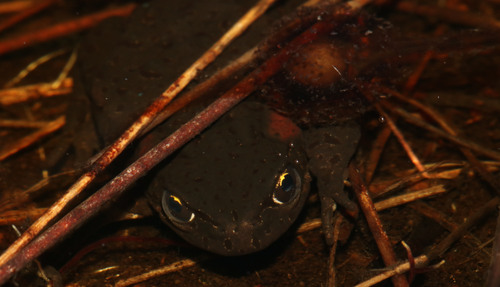
Western Leopard Toad

Western Leopard Toad

Sclerophrys pantherina

Silhouette: Michael Scroggie, from original photograph by Gary M. Stolz, USFWS (original photograph in public domain). · PhyloPic

LCNTVUENEndangeredCR Endemic
Daily sighting probability ~40% · Likely
at Table Mountain National Park

In 3 days ~80% in a week >90%

6,140 Verified sightings at Table Mountain National Park From 2019 to 2026
6,140 In 1 park
August Best month
🌙 Nocturnal When it's spotted

About the Western Leopard Toad

The western leopard toad (Sclerophrys pantherina) is a species of toad in the family Bufonidae. The species is endemic to the low-lying areas of the Cape Peninsula, the Cape Flats and the Agulhas flats of the Western Cape, South Africa.

Two macro-populations exist, broadly referred to as the Cape Town and Overberg clusters. Its natural foraging habitat is Mediterranean-type shrubby vegetation, falling within several vegetation types including Cape Flats Sand Plain Fynbos and Cape Flats Dune Strandveld.

The species is not restricted to pristine habitat as much of its historical feeding grounds currently fall under residential suburbs, hence leopard toads are often found living in suburban gardens. Breeding habitat includes swamps, freshwater lakes, intermittent freshwater lakes, freshwater marshes, intermittent freshwater marshes, urban riverine watercourses, natural ponds and garden ponds.

It is threatened by habitat loss, as well as other urban obstacles and barriers such as walls, electric fencing, canals and roads. Introduced or exotic fauna and flora like ducks, fish and algae threaten the quality of breeding habitat and the... Wikipedia →

Sounds

Recording0:08

South Africa · 2025

© Kurt van Wyk · iNaturalist · CC BY-NC 4.0

Recording1:05

South Africa · 2024

© margiejarvis · iNaturalist · CC BY-NC 4.0

Recording0:07

South Africa · 2021

© Tony Rebelo · iNaturalist · CC BY-SA 4.0

Global Distribution

Parks Where Found

# Park Country Daily sighting probability
1 Table Mountain National Park 🇿🇦 South Africa
~40%

More parks will be added in future updates.

Cities Where Found

# City Country Daily sighting probability
1 Cape Town 🇿🇦 South Africa
~40%

Zoos & Centres Where Found

# Zoo / Centre Country
1 Oregon Zoo 🇺🇸 United States In captivity
2 Two Oceans Aquarium 🇿🇦 South Africa In captivity

Before you go

What are the chances of seeing a Western Leopard Toad in Table Mountain National Park?

Likely

About 40% of wildlife watchers report a Western Leopard Toad sighting in Table Mountain National Park on a given day, based on 6,140 verified sightings from GBIF citizen-science data from 2019 to 2026. It is the most-seen of the 18 amphibians we can rate there. Over three days the chance rises to about 80%, and over a week to over 90%, if each day is a fresh chance.

When is the best time to see a Western Leopard Toad in Table Mountain National Park?

August

In that month about 80% of wildlife watchers report a Western Leopard Toad in Table Mountain National Park on a given day, against about 20% in April, the lowest month. That is one of Table Mountain National Park's wettest months, with about 70 mm of rain against 15 mm in February.

What time of day is best to see a Western Leopard Toad?

Between 7 and 10 pm

Across all the parks we cover, that three-hour window holds the most Western Leopard Toad sightings with a recorded time, and about 9 in 10 of them come between 6 pm and 6 am: it is mostly seen at night.

Where else can you see a Western Leopard Toad?

Only Table Mountain National Park, in our data

Table Mountain National Park is the only park on Wallace's Line with enough records to rate Western Leopard Toad sightings: about 40% of wildlife watchers there report one on a given day.

Where does the Western Leopard Toad sighting chance come from?

GBIF citizen-science records

It is estimated from how often the Western Leopard Toad is recorded against all the amphibians logged in Table Mountain National Park (6,140 verified sightings from 2019 to 2026), calibrated against known sighting rates. Figures are rounded to the nearest 10% because citizen-science data supports honest approximations, not decimals, and months with records from fewer than five people show "—". How it works.

← Back to Table Mountain National Park