

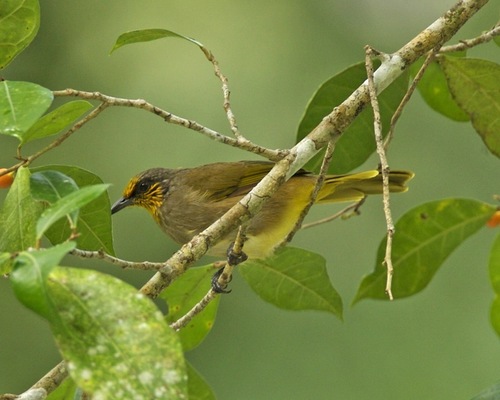
Malaysian Rail-babbler

Malaysian Rail-babbler

Eupetes macrocerus

Silhouette: Sheatherius · PhyloPic

LCNTNear ThreatenedVUENCR
Daily sighting probability ~10% · With luck
at Taman Negara National Park

In 3 days ~20% in a week ~40%

96 Verified sightings at Taman Negara National Park From 2019 to 2026
96 In 1 park
September Best month
☀️ Diurnal When it's spotted

About the Malaysian Rail-babbler

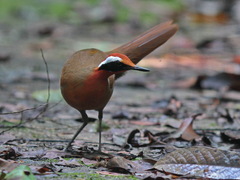
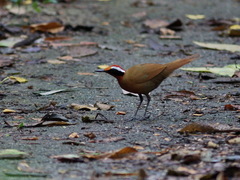
The rail-babbler or Malaysian rail-babbler (Eupetes macrocerus) is a brown and pied rail-like ground-living bird. It is the only species in the genus Eupetes and family Eupetidae. It lives on the floor of primary forests in the Malay Peninsula and Sumatra (the nominate subspecies macrocerus), as well as Borneo (ssp. borneensis). It is distantly related to African rockfowl. Its population has greatly decreased because much of the lowland primary forest has been cut, and secondary forests usually have too dense a bottom vegetation or do not offer enough shade to be favourable for the species. However, it is locally still common in logged forest or on hill-forest on slopes, and probably not in immediate danger of extinction. The species is poorly known and rarely seen, in no small part due to its shyness.

Opinions on the correct taxonomic placement for the rail-babbler have differed. At one time, it was placed in the Old World babbler family, Timaliidae. Until recently, it had been regarded as being related to a group which included the quail-thrushes and whipbirds, and placed in the family Cinclosomatidae (previously in Orthonychidae when the members of the Cinclosomatidae... Wikipedia →

Sounds

Song1:07

Malaysia · 1984

© Jelle Scharringa · XC629820 · CC BY-NC-SA 4.0

Call0:13

Malaysia · 2026

© Kim Chuah Lim · XC1151663 · CC BY-NC-SA 4.0

Alarm call0:18

Malaysia · 2024

© Ding Li Yong · XC899317 · CC BY-NC-ND 4.0

Global Distribution

Parks Where Found

# Park Country Daily sighting probability
1 Taman Negara National Park 🇲🇾 Malaysia
~10%

More parks will be added in future updates.

Before you go

What are the chances of seeing a Malaysian Rail-babbler in Taman Negara National Park?

With luck

About 10% of wildlife watchers report a Malaysian Rail-babbler sighting in Taman Negara National Park on a given day, based on 96 verified sightings from GBIF citizen-science data from 2019 to 2026. It is the 132nd most-seen of the 293 birds we can rate there. Over three days the chance rises to about 20%, and over a week to about 40%, if each day is a fresh chance.

When is the best time to see a Malaysian Rail-babbler in Taman Negara National Park?

May–October and December

In those months about 10% of wildlife watchers report a Malaysian Rail-babbler in Taman Negara National Park on a given day, against under 5% in January–April and November, the lowest months.

What time of day is best to see a Malaysian Rail-babbler?

Between 9 am and noon

Across all the parks we cover, that three-hour window holds the most Malaysian Rail-babbler sightings with a recorded time, and about 9 in 10 of them come between 6 am and 6 pm: it is a daytime animal.

Where else can you see a Malaysian Rail-babbler?

Only Taman Negara National Park, in our data

Taman Negara National Park is the only park on Wallace's Line with enough records to rate Malaysian Rail-babbler sightings: about 10% of wildlife watchers there report one on a given day.

Which relatives of the Malaysian Rail-babbler live in Taman Negara National Park?

Same order: Passeriformes

The closest relatives of the Malaysian Rail-babbler that you can see in Taman Negara National Park (order Passeriformes, Perching Birds) are Greater Racket-tailed Drongo (about 50%), Oriental Magpie-Robin (about 50%) and Red-eyed Bulbul (about 50%), with each one's daily chance of a sighting.

Where does the Malaysian Rail-babbler sighting chance come from?

GBIF citizen-science records

It is estimated from how often the Malaysian Rail-babbler is recorded against all the birds logged in Taman Negara National Park (96 verified sightings from 2019 to 2026), calibrated against known sighting rates. Figures are rounded to the nearest 10% because citizen-science data supports honest approximations, not decimals, and months with records from fewer than five people show "—". How it works.

← Back to Taman Negara National Park