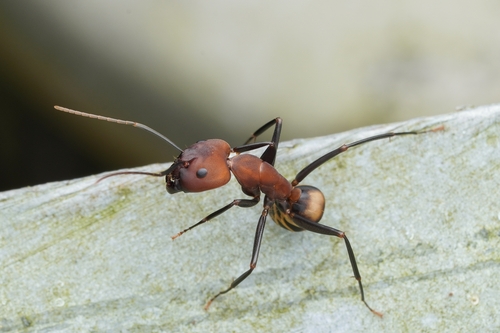
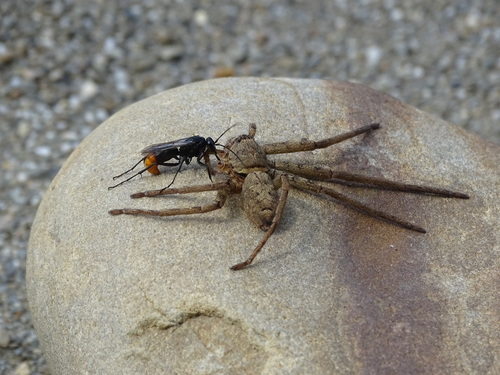
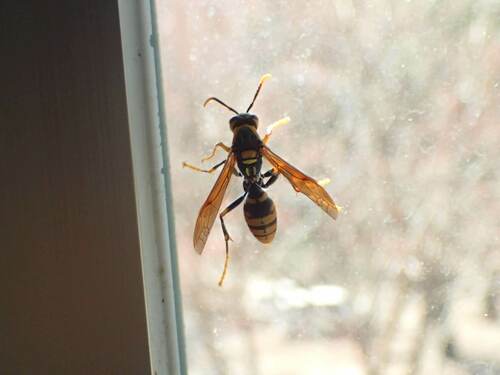
Asian Giant Hornet
Daily sighting probability ~20% · Possible
at Taroko National Park

In 3 days ~40% in a week ~70%

23 Verified sightings at Taroko National Park From 2019 to 2026
23 In 1 park
October Best month
☀️ Diurnal When it's spotted

About the Asian Giant Hornet

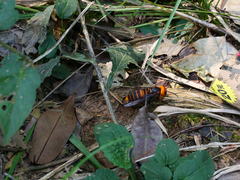
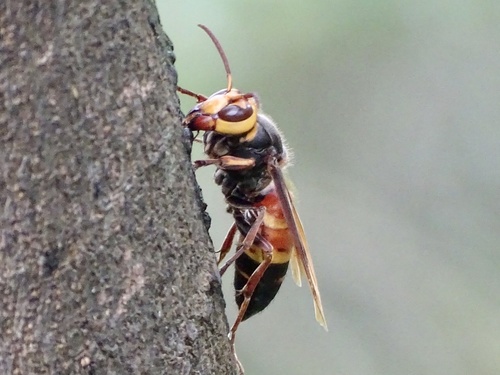
The Asian giant hornet (Vespa mandarinia), also known as the northern giant hornet, is the world's largest hornet. It is native to temperate and tropical East Asia, South Asia, mainland Southeast Asia, and parts of the Russian Far East. It was also briefly found in the Pacific Northwest of North America from late 2019 but was eradicated by December 2024.

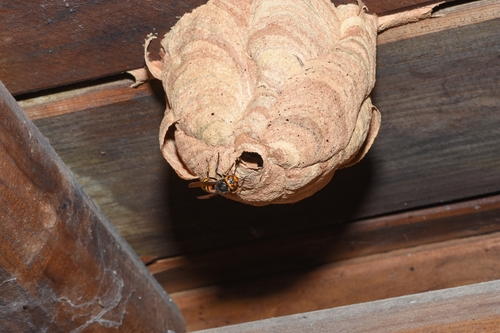
Asian giant hornets prefer to live in low mountains and forests, while almost completely avoiding plains and high-altitude climates. They create nests by digging, co-opting pre-existing tunnels dug by rodents, or occupying spaces near rotten pine roots. The Asian giant hornet feeds primarily on larger insects, colonies of other eusocial insects, tree sap, and honey from honeybee colonies. It has a body length of 45 mm (1+3⁄4 in), a wingspan around 75 mm (3 in), and a stinger 6 mm (1⁄4 in) long, which injects a large amount of potent venom.

V. mandarinia is a species in the genus Vespa, which comprises all true hornets. Along with seven other species, V. mandarinia is a part of the V. tropica species group, defined by the single notch located on the apical margin of the seventh gastral sternum of the male... Wikipedia →

Global Distribution

Parks Where Found

# Park Country Daily sighting probability
1 Taroko National Park 🇹🇼 Taiwan
~20%

More parks will be added in future updates.

Cities Where Found

# City Country Daily sighting probability
1 Hefei 🇨🇳 China
~30%
2 Wuhan 🇨🇳 China
~20%
3 Nagoya 🇯🇵 Japan
~20%
4 Osaka 🇯🇵 Japan
~20%
5 Sendai 🇯🇵 Japan
~10%
6 Kunming 🇨🇳 China
~10%
7 Nanjing 🇨🇳 China
~10%
8 Tokyo 🇯🇵 Japan
~10%
9 Seoul 🇰🇷 South Korea
~10%
10 Hangzhou 🇨🇳 China
~10%

Before you go

What are the chances of seeing an Asian Giant Hornet in Taroko National Park?

Possible

About 20% of wildlife watchers report an Asian Giant Hornet sighting in Taroko National Park on a given day, based on 23 verified sightings from GBIF citizen-science data from 2019 to 2026. It is the 83rd most-seen of the 447 insects we can rate there. Over three days the chance rises to about 40%, and over a week to about 70%, if each day is a fresh chance.

When is the best time to see an Asian Giant Hornet in Taroko National Park?

October

In that month about 40% of wildlife watchers report an Asian Giant Hornet in Taroko National Park on a given day, against under 5% in January–February and July, the lowest months. That is one of Taroko National Park's wettest months, with about 570 mm of rain against 290 mm in December.

What time of day is best to see an Asian Giant Hornet?

Between 9 am and noon

Across all the parks we cover, that three-hour window holds the most Asian Giant Hornet sightings with a recorded time, and nearly all of them come between 6 am and 6 pm: it is a daytime animal.

Where else can you see an Asian Giant Hornet?

Only Taroko National Park, in our data

Taroko National Park is the only park on Wallace's Line with enough records to rate Asian Giant Hornet sightings: about 20% of wildlife watchers there report one on a given day.

Which relatives of the Asian Giant Hornet live in Taroko National Park?

Same genus: Vespa

The closest relatives of the Asian Giant Hornet that you can see in Taroko National Park (genus Vespa, Hornets) are Black-Tailed Hornet (about 20%), Black-Bellied Hornet (about 20%) and Yellow-Legged Hornet (about 20%), with each one's daily chance of a sighting.

Where does the Asian Giant Hornet sighting chance come from?

GBIF citizen-science records

It is estimated from how often the Asian Giant Hornet is recorded against all the insects logged in Taroko National Park (23 verified sightings from 2019 to 2026), calibrated against known sighting rates. Figures are rounded to the nearest 10% because citizen-science data supports honest approximations, not decimals, and months with records from fewer than five people show "—". How it works.

← Back to Taroko National Park