Austral Blackbird

Austral Blackbird

Curaeus curaeus

Silhouette: Sheatherius · PhyloPic

LCLeast ConcernNTVUENCR
Daily sighting probability ~20% · Possible
at Tierra del Fuego National Park

In 3 days ~40% in a week ~70%

181 Verified sightings at Tierra del Fuego National Park From 2019 to 2026
1,286 In all 4 parks
October Best month
☀️ Diurnal When it's spotted

About the Austral Blackbird

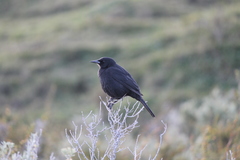
The austral blackbird (Curaeus curaeus) is a species of bird in the family Icteridae. It is found in Argentina and Chile, and it migrates to regions close by. Its natural habitats are temperate forests, subtropical or tropical high-altitude shrubland, and heavily degraded former forest.

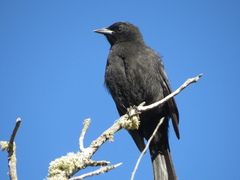
Its plumage is entirely black with a slight bluish hint, and its physical features consist of black legs, black eyes, and a sharp beak with missing pigmentation in the head, chest, and wings. Compared to other birds in its family, the Austral Blackbird has a highly varied voice, and they do a lot of singing and calling together.

Their main habitats are woodlands, forests, lakeshores, beaches, fields, valley bottoms, and rocky shores. It is commonly found in small flocks of 6 to 20 in and around the forest, and never in the open land. Can be commonly found in protected areas in national parks around Chile and Argentina. They are found in protected areas where the conditions support proper living and breeding.

They are typically drawn to nectar and like feeding on different kinds of flowers. When the bird feeds on these plants it will create a yellow color... Wikipedia →

Sounds

Song0:13

Chile · 2022

© Nicolas Vilches · XC820501 · CC BY-NC-SA 4.0

Call0:16

Chile · 2022

© Cristian Pinto Fernandez · XC714524 · CC BY-NC-SA 4.0

Begging call0:51

Chile · 2017

© Cristian Pinto · XC439580 · CC BY-NC-SA 4.0

Global Distribution

Parks Where Found

# Park Country Daily sighting probability
1 Torres del Paine National Park 🇨🇱 Chile
~40%
2 Vicente Pérez Rosales National Park 🇨🇱 Chile
~30%
3 Nahuel Huapi National Park 🇦🇷 Argentina
~30%
4 Tierra del Fuego National Park 🇦🇷 Argentina
~20%

Cities Where Found

# City Country Daily sighting probability
1 Santiago 🇨🇱 Chile
~60%

Before you go

What are the chances of seeing an Austral Blackbird in Tierra del Fuego National Park?

Possible

About 20% of wildlife watchers report an Austral Blackbird sighting in Tierra del Fuego National Park on a given day, based on 181 verified sightings from GBIF citizen-science data from 2019 to 2026. It is the 36th most-seen of the 78 birds we can rate there. Over three days the chance rises to about 40%, and over a week to about 70%, if each day is a fresh chance.

When is the best time to see an Austral Blackbird in Tierra del Fuego National Park?

October

In that month about 40% of wildlife watchers report an Austral Blackbird in Tierra del Fuego National Park on a given day, against about 10% in July–August and December–May, the lowest months. June has too few records to rate.

What time of day is best to see an Austral Blackbird?

Between 11 am and 2 pm

Across all the parks we cover, that three-hour window holds the most Austral Blackbird sightings with a recorded time, and about 9 in 10 of them come between 6 am and 6 pm: it is a daytime animal.

Which relatives of the Austral Blackbird live in Tierra del Fuego National Park?

Same order: Passeriformes

The closest relatives of the Austral Blackbird that you can see in Tierra del Fuego National Park (order Passeriformes, Perching Birds) are Patagonian Sierra-Finch (about 90%), Austral Thrush (about 90%) and Rufous-collared Sparrow (about 80%), with each one's daily chance of a sighting.

Where does the Austral Blackbird sighting chance come from?

GBIF citizen-science records

It is estimated from how often the Austral Blackbird is recorded against all the birds logged in Tierra del Fuego National Park (181 verified sightings from 2019 to 2026), calibrated against known sighting rates. Figures are rounded to the nearest 10% because citizen-science data supports honest approximations, not decimals, and months with records from fewer than five people show "—". How it works.

← Back to Tierra del Fuego National Park