Sei Whale

Sei Whale

Balaenoptera borealis

Silhouette: Chris huh · PhyloPic

LCNTVUENEndangeredCR
Daily sighting probability ~10% · With luck
at Tierra del Fuego National Park

In 3 days ~30% in a week ~60%

16 Verified sightings at Tierra del Fuego National Park From 2019 to 2026
16 In 1 park
April Best month
☀️🌙 Day & Night When it's spotted

About the Sei Whale

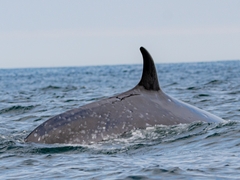
The sei whale ( SAY; Balaenoptera borealis) is a baleen whale. It is one of ten rorqual species, and the third-largest member after the blue and fin whales. It can grow to 19.5 m (64 ft) in length and weigh as much as 28 t (28 long tons; 31 short tons). The whale's ventral surface has sporadic markings ranging from light grey to white, and its body is usually dark steel grey in colour. It is among the fastest of all cetaceans, and can reach speeds of up to 50–55 km/h (31–34 mph) over short distances.

It inhabits most oceans and adjoining seas, and prefers deep offshore waters. It avoids polar and tropical waters and semi-enclosed bodies of water. The sei whale migrates annually from cool, subpolar waters in summer to temperate, subtropical waters in winter with a lifespan of 70 years. It is a filter feeder, with its diet consisting primarily of copepods, krill, and other zooplankton. It is typically solitary or can be found in groups numbering half a dozen. During the breeding period, a mating pair will remain together. Sei whale vocalizations usually last approximately half a second, and occur at 240–625 hertz.

Following large-scale commercial whaling during the late 19th and 20th centuries, when over 255,000 whales were killed, the sei whale is now internationally protected. It is listed as endangered on the IUCN Red List, though populations are increasing. The Northern Hemisphere population is listed under CITES Appendix II, which indicates they are not threatened with extinction, while the Southern Hemisphere population is listed under CITES Appendix I, indicating that they are threatened and are given the highest levels of protection. Wikipedia →

Global Distribution

Parks Where Found

# Park Country Daily sighting probability
1 Tierra del Fuego National Park 🇦🇷 Argentina
~10%

More parks will be added in future updates.

Before you go

What are the chances of seeing a Sei Whale in Tierra del Fuego National Park?

With luck

About 10% of wildlife watchers report a Sei Whale sighting in Tierra del Fuego National Park on a given day, based on 16 verified sightings from GBIF citizen-science data from 2019 to 2026. It is the 7th most-seen of the 7 mammals we can rate there. Over three days the chance rises to about 30%, and over a week to about 60%, if each day is a fresh chance.

When is the best time to see a Sei Whale in Tierra del Fuego National Park?

March and April

In those months about 20% of wildlife watchers report a Sei Whale in Tierra del Fuego National Park on a given day, against under 5% in June–September and November, the lowest months.

What time of day is best to see a Sei Whale?

Between 4 and 7 pm

Across all the parks we cover, that three-hour window holds the most Sei Whale sightings with a recorded time, and about 7 in 10 of them come between 6 am and 6 pm: it is seen both by day and at night.

Where else can you see a Sei Whale?

Only Tierra del Fuego National Park, in our data

Tierra del Fuego National Park is the only park on Wallace's Line with enough records to rate Sei Whale sightings: about 10% of wildlife watchers there report one on a given day.

Where does the Sei Whale sighting chance come from?

GBIF citizen-science records

It is estimated from how often the Sei Whale is recorded against all the mammals logged in Tierra del Fuego National Park (16 verified sightings from 2019 to 2026), calibrated against known sighting rates. Figures are rounded to the nearest 10% because citizen-science data supports honest approximations, not decimals, and months with records from fewer than five people show "—". How it works.

← Back to Tierra del Fuego National Park