Alpine Salamander

Alpine Salamander

Salamandra atra

Silhouette: Mattia Menchetti / Yan Wong · PhyloPic

LCLeast ConcernNTVUENCR
Daily sighting probability ~50% · Likely
at Triglav National Park

In 3 days ~80% in a week >90%

65 Verified sightings at Triglav National Park From 2019 to 2026
113 In all 2 parks
July Best month
☀️ Diurnal When it's spotted

About the Alpine Salamander

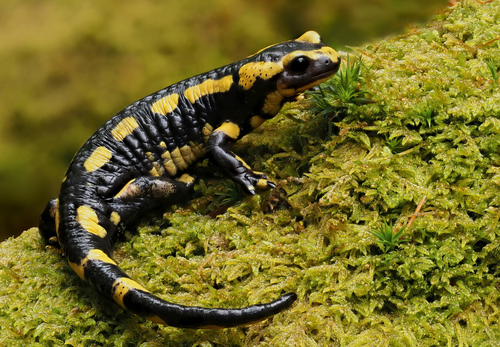
The alpine salamander (Salamandra atra) is a black salamander that can be found in the Alps, and through the mountainous range in Europe. It is a member of the genus Salamandra. The species name, atra, is derived from the Latin ater, meaning dull black. The colour of salamanders has evolved over time, as some species are completely monochrome black, and others have yellow spotting and marks. Their life expectancy is at least 10 years. There are four subspecies of the alpine salamander, with varied distribution and physical colour. Unlike other salamanders, whose larvae develop in water, the alpine salamander and its subspecies are fully terrestrial species in life and gestation. They give birth to live young.

Alpine salamanders produce toxic compounds from their skin. These compounds may protect them from both predator and microbial threats. Alpine salamanders are often small in size, and dark brown or black. Members of the subspecies are not wholly black or brown monochrome, but rather have mosaic or spotted patterns. Members of the subspecies Salamandra atra aurorae have bright splotches on its dorsal side and head. The colour is often bright yellow, but can range... Wikipedia →

Global Distribution

Parks Where Found

# Park Country Daily sighting probability
1 Hohe Tauern National Park 🇦🇹 Austria
~50%
2 Triglav National Park 🇸🇮 Slovenia
~50%

Before you go

What are the chances of seeing an Alpine Salamander in Triglav National Park?

Likely

About 50% of wildlife watchers report an Alpine Salamander sighting in Triglav National Park on a given day, based on 65 verified sightings from GBIF citizen-science data from 2019 to 2026. It is the 3rd most-seen of the 6 amphibians we can rate there. Over three days the chance rises to about 80%, and over a week to over 90%, if each day is a fresh chance.

When is the best time to see an Alpine Salamander in Triglav National Park?

July to September

In those months about 60% of wildlife watchers report an Alpine Salamander in Triglav National Park on a given day, against under 5% in March and April, the lowest months.

What time of day is best to see an Alpine Salamander?

Between 8 and 11 am

Across all the parks we cover, that three-hour window holds the most Alpine Salamander sightings with a recorded time, and about 8 in 10 of them come between 6 am and 6 pm: it is a daytime animal.

Is Triglav National Park the best place to see an Alpine Salamander?

Among the best

Of the 2 parks where we can rate Alpine Salamander sightings, Triglav National Park ranks 2nd at about 50%, level with the leaders once rounded. The best odds are in Hohe Tauern National Park (Austria, about 50%).

Where does the Alpine Salamander sighting chance come from?

GBIF citizen-science records

It is estimated from how often the Alpine Salamander is recorded against all the amphibians logged in Triglav National Park (65 verified sightings from 2019 to 2026), calibrated against known sighting rates. Figures are rounded to the nearest 10% because citizen-science data supports honest approximations, not decimals, and months with records from fewer than five people show "—". How it works.

← Back to Triglav National Park