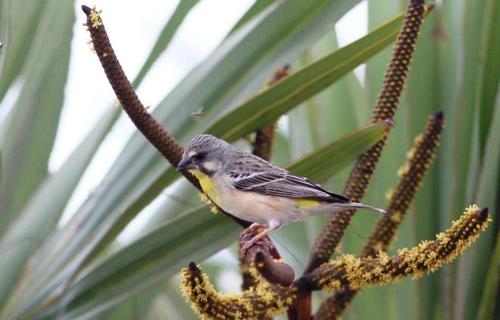
Lemon-breasted Seedeater

Lemon-breasted Seedeater

Crithagra citrinipectus

Silhouette: Sheatherius · PhyloPic

LCLeast ConcernNTVUENCR
Daily sighting probability <5% · Rare
at uMkhuze Game Reserve

In 3 days ~10% in a week ~20%

19 Verified sightings at uMkhuze Game Reserve From 2019 to 2026
197 In all 5 parks
April Best month
☀️ Diurnal When it's spotted

About the Lemon-breasted Seedeater

The lemon-breasted canary (Crithagra citrinipectus), also known as the lemon-breasted seedeater, is a species of finch in the family Fringillidae. It is found in Malawi, Mozambique, South Africa, Zambia, and Zimbabwe. Its natural habitats are dry savannah, subtropical or tropical dry shrubland, and rural gardens.

The lemon-breasted canary was identified as species in 1960 by Clancey and Lawson from a type obtained near Panda, in Inhambane Province of southern Mozambique. Research involving mitochondrial DNA analysis suggests that this species along with S. leucopygia, S. mozambicus, and S. dorsostriatus belong in a separate genus, Ochrospiza, as they have been revealed to be only distantly related to other African members of the present genus, Serinus. However, before a revision can be made, a detailed inspection of all the taxa in the current genus is necessary. Some consider this species to be a hybrid between S. atrogularis and S. mozambicus.

The lemon-breasted canary was formerly placed in the genus Serinus but phylogenetic analysis using mitochondrial and nuclear DNA sequences found that the genus was polyphyletic. The genus was therefore split and... Wikipedia →

Sounds

Call0:25

Mozambique · 2017

© Samuel Jones · XC395992 · CC BY-NC-ND 4.0

Global Distribution

Parks Where Found

# Park Country Daily sighting probability
1 Gonarezhou National Park 🇿🇼 Zimbabwe
~10%
2 iSimangaliso Wetland Park 🇿🇦 South Africa
<5%
3 uMkhuze Game Reserve 🇿🇦 South Africa
<5%
4 Hluhluwe-Imfolozi Park 🇿🇦 South Africa
<5%
5 Kruger National Park 🇿🇦 South Africa
<5%

Before you go

What are the chances of seeing a Lemon-breasted Seedeater in uMkhuze Game Reserve?

Rare

Under 5% of wildlife watchers report a Lemon-breasted Seedeater sighting in uMkhuze Game Reserve on a given day, based on 19 verified sightings from GBIF citizen-science data from 2019 to 2026. It is the 221st most-seen of the 283 birds we can rate there. Over three days the chance rises to about 10%, and over a week to about 20%, if each day is a fresh chance.

When is the best time to see a Lemon-breasted Seedeater in uMkhuze Game Reserve?

January, April–May, August and October

In those months about 10% of wildlife watchers report a Lemon-breasted Seedeater in uMkhuze Game Reserve on a given day, against under 5% in February–March, June–July, September and November–December, the lowest months.

What time of day is best to see a Lemon-breasted Seedeater?

Between 8 and 11 am

Across all the parks we cover, that three-hour window holds the most Lemon-breasted Seedeater sightings with a recorded time, and nearly all of them come between 6 am and 6 pm: it is a daytime animal.

Is uMkhuze Game Reserve the best place to see a Lemon-breasted Seedeater?

3rd of 5

Of the 5 parks where we can rate Lemon-breasted Seedeater sightings, uMkhuze Game Reserve ranks 3rd at under 5%. The best odds are in Gonarezhou National Park (Zimbabwe, about 10%) and iSimangaliso Wetland Park (South Africa, under 5%).

Where does the Lemon-breasted Seedeater sighting chance come from?

GBIF citizen-science records

It is estimated from how often the Lemon-breasted Seedeater is recorded against all the birds logged in uMkhuze Game Reserve (19 verified sightings from 2019 to 2026), calibrated against known sighting rates. Figures are rounded to the nearest 10% because citizen-science data supports honest approximations, not decimals, and months with records from fewer than five people show "—". How it works.

← Back to uMkhuze Game Reserve