Neergaard's Sunbird

Neergaard's Sunbird

Cinnyris neergaardi

Silhouette: Sheatherius · PhyloPic

LCNTNear ThreatenedVUENCR
Daily sighting probability ~20% · Possible
at uMkhuze Game Reserve

In 3 days ~50% in a week ~80%

105 Verified sightings at uMkhuze Game Reserve From 2019 to 2026
163 In all 2 parks
December Best month
☀️ Diurnal When it's spotted

About the Neergaard's Sunbird

Neergaard's sunbird (Cinnyris neergaardi) is a species of bird in the family Nectariniidae. It is found in Mozambique and South Africa. Its natural habitat is subtropical or tropical dry forest near the coast, where it is threatened by habitat loss. It is named after Paul Neergaard, a Danish recruiting officer for the Wenela agency, who was stationed in southern Mozambique.

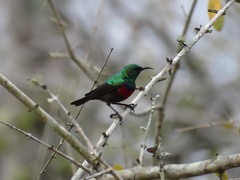
Neergaard's sunbird is a small species with a relatively short beak. The adult male has a metallic green head, back, and throat, black wings, a blue rump, and a brownish-black tail. It has yellow pectoral tufts, a narrow blue collar, a scarlet lower breast, and a black belly. The adult female has a greyish-brown head and upper parts, an olive-brown rump, and a dark brown tail. There is a pale supercilium over the eye, and the underparts are pale greyish brown. The eyes in both sexes are dark brown, and the beak and legs are black. The juvenile resembles the female.

Neergaard's sunbird feeds in the canopy, often in the company of the amethyst sunbird (Chalcomitra amethystina). It feeds on nectar, insects, and spiders. Neergaard's sunbird has a limited range and a moderately... Wikipedia →

Sounds

Song0:15

South Africa · 2022

© Maarten Sluijter · XC813911 · CC BY-NC-SA 4.0

Song0:22

South Africa · 2018

© Murray Christian · XC449693 · CC BY-NC-SA 4.0

Song0:40

South Africa · 2016

© Lisa Boocock · XC349553 · CC BY-NC-SA 4.0

Global Distribution

Parks Where Found

# Park Country Daily sighting probability
1 uMkhuze Game Reserve 🇿🇦 South Africa
~20%
2 iSimangaliso Wetland Park 🇿🇦 South Africa
<5%

Before you go

What are the chances of seeing a Neergaard's Sunbird in uMkhuze Game Reserve?

Possible

About 20% of wildlife watchers report a Neergaard's Sunbird sighting in uMkhuze Game Reserve on a given day, based on 105 verified sightings from GBIF citizen-science data from 2019 to 2026. It is the 106th most-seen of the 283 birds we can rate there. Over three days the chance rises to about 50%, and over a week to about 80%, if each day is a fresh chance.

When is the best time to see a Neergaard's Sunbird in uMkhuze Game Reserve?

December

In that month about 40% of wildlife watchers report a Neergaard's Sunbird in uMkhuze Game Reserve on a given day, against about 10% in February–April and July–August, the lowest months. That is one of uMkhuze Game Reserve's wettest months, with about 85 mm of rain against 15 mm in July.

What time of day is best to see a Neergaard's Sunbird?

Between 6 and 9 am

Across all the parks we cover, that three-hour window holds the most Neergaard's Sunbird sightings with a recorded time, and about 9 in 10 of them come between 6 am and 6 pm: it is a daytime animal.

Is uMkhuze Game Reserve the best place to see a Neergaard's Sunbird?

Yes

Of the 2 parks where we can rate Neergaard's Sunbird sightings, uMkhuze Game Reserve has the highest daily chance: about 20%. Next come iSimangaliso Wetland Park (South Africa, under 5%).

Which relatives of the Neergaard's Sunbird live in uMkhuze Game Reserve?

Same genus: Cinnyris

The closest relatives of the Neergaard's Sunbird that you can see in uMkhuze Game Reserve (genus Cinnyris, Cinnyris Sunbirds) are White-breasted Sunbird (about 60%), Purple-banded Sunbird (about 40%) and Mariqua Sunbird (about 20%), with each one's daily chance of a sighting.

Where does the Neergaard's Sunbird sighting chance come from?

GBIF citizen-science records

It is estimated from how often the Neergaard's Sunbird is recorded against all the birds logged in uMkhuze Game Reserve (105 verified sightings from 2019 to 2026), calibrated against known sighting rates. Figures are rounded to the nearest 10% because citizen-science data supports honest approximations, not decimals, and months with records from fewer than five people show "—". How it works.

← Back to uMkhuze Game Reserve