Southern Red-fronted Tinkerbird

Southern Red-fronted Tinkerbird

Pogoniulus pusillus

Silhouette: PhyloPic

LCLeast ConcernNTVUENCR
Daily sighting probability ~30% · Possible
at uMkhuze Game Reserve

In 3 days ~60% in a week ~90%

146 Verified sightings at uMkhuze Game Reserve From 2019 to 2026
310 In all 4 parks
October Best month
☀️ Diurnal When it's spotted

About the Southern Red-fronted Tinkerbird

The southern red-fronted tinkerbird, (Pogoniulus pusillus) is a small bird in the African barbet family Lybiidae. It is found in southern Mozambique and eastern South Africa. This species was formerly regarded as conspecific with the northern red-fronted tinkerbird (Pogoniulus uropygialis).

The southern red-fronted tinkerbird is associated with juniper forest and scrub. It nests in a tree hole and lays two or three eggs. It eats berries and fruit, particularly mistletoe, but also takes insects as it forages in deep cover.

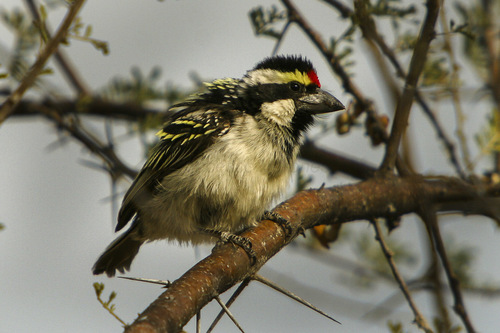
The southern red-fronted tinkerbird is 9–10.5 cm (3.5–4.1 in) in length. It is a plump bird, with a short neck, large head, and short tail. The adult has black upper parts heavily streaked with yellow and white, and a golden wing patch. Its head has a strong black and white pattern, with a red forecrown spot. Its underparts and rump are lemon yellow. Sexes are similar in appearance, but young birds lack the red forehead.

This species is distinguished from the yellow-fronted tinkerbird by the colour of the forehead spot, the golden wing patch, and its overall darker appearance. It is often confused with the red-fronted barbet, but it is significantly... Wikipedia →

Sounds

Song0:46

South Africa · 2023

© Albert Lastukhin · XC895540 · CC BY-NC-ND 4.0

Call0:19

Kenya · 2022

© isaac kilusu · XC736069 · CC BY-NC-SA 4.0

Song0:22

South Africa · 2022

© Maarten Sluijter · XC802688 · CC BY-NC-SA 4.0

Global Distribution

Parks Where Found

# Park Country Daily sighting probability
1 uMkhuze Game Reserve 🇿🇦 South Africa
~30%
2 Hluhluwe-Imfolozi Park 🇿🇦 South Africa
~10%
3 iSimangaliso Wetland Park 🇿🇦 South Africa
~10%
4 Addo Elephant National Park 🇿🇦 South Africa
<5%

Cities Where Found

# City Country Daily sighting probability
1 Durban 🇿🇦 South Africa
<5%

Before you go

What are the chances of seeing a Southern Red-fronted Tinkerbird in uMkhuze Game Reserve?

Possible

About 30% of wildlife watchers report a Southern Red-fronted Tinkerbird sighting in uMkhuze Game Reserve on a given day, based on 146 verified sightings from GBIF citizen-science data from 2019 to 2026. It is the 82nd most-seen of the 283 birds we can rate there. Over three days the chance rises to about 60%, and over a week to about 90%, if each day is a fresh chance.

When is the best time to see a Southern Red-fronted Tinkerbird in uMkhuze Game Reserve?

October

In that month about 50% of wildlife watchers report a Southern Red-fronted Tinkerbird in uMkhuze Game Reserve on a given day, against about 10% in July, the lowest month.

What time of day is best to see a Southern Red-fronted Tinkerbird?

Between 8 and 11 am

Across all the parks we cover, that three-hour window holds the most Southern Red-fronted Tinkerbird sightings with a recorded time, and nearly all of them come between 6 am and 6 pm: it is a daytime animal.

Is uMkhuze Game Reserve the best place to see a Southern Red-fronted Tinkerbird?

Yes

Of the 4 parks where we can rate Southern Red-fronted Tinkerbird sightings, uMkhuze Game Reserve has the highest daily chance: about 30%. Next come Hluhluwe-Imfolozi Park (South Africa, about 10%) and iSimangaliso Wetland Park (South Africa, about 10%).

Where does the Southern Red-fronted Tinkerbird sighting chance come from?

GBIF citizen-science records

It is estimated from how often the Southern Red-fronted Tinkerbird is recorded against all the birds logged in uMkhuze Game Reserve (146 verified sightings from 2019 to 2026), calibrated against known sighting rates. Figures are rounded to the nearest 10% because citizen-science data supports honest approximations, not decimals, and months with records from fewer than five people show "—". How it works.

← Back to uMkhuze Game Reserve