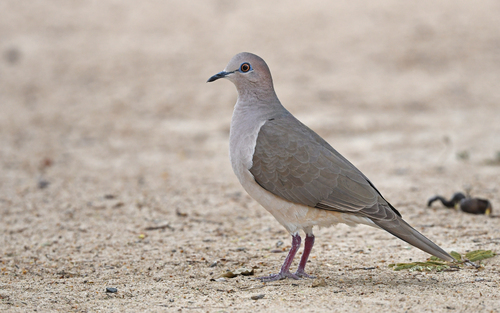
Dusky Pigeon

Dusky Pigeon

Patagioenas goodsoni

Silhouette: Ferran Sayol · PhyloPic

LCLeast ConcernNTVUENCR
Daily sighting probability ~50% · Likely
at Utría National Natural Park

In 3 days ~80% in a week >90%

45 Verified sightings at Utría National Natural Park From 2019 to 2026
77 In all 2 parks
February Best month
☀️ Diurnal When it's spotted

About the Dusky Pigeon

The dusky pigeon (Patagioenas goodsoni) is a species of bird in the family Columbidae. It is found in Colombia and Ecuador. The dusky pigeon is most closely related to the ruddy pigeon (P. subvinacea), short-billed pigeon (P. nigrirostris), and plumbeous pigeon (P. plumbia), and they have sometimes been placed in subgenus Oenoenas. The dusky pigeon is monotypic.

The dusky pigeon is about 24 cm (9.4 in) long. Its head, throat, and breast are gray or purplish gray. Its nape is gray glossed with purple. Its shoulders, back, and rump are olive brown or dark purplish brown. The wings and tail are bronzy gray, sometimes glossed with purple. Its eye can be any of several shades of red.

The dusky pigeon is found in the Chocó Biogeographic Region from Colombia near the Panamanian border south to the Río Palenque in northwestern Ecuador. It inhabits rainforest, mostly in lowlands but as high as 1,500 m (4,900 ft) in elevation.

No information on the dusky pigeon's foraging behavior or diet has been published. Specimens of dusky pigeon in breeding condition were taken between... Wikipedia →

Sounds

Song0:16

Ecuador · 2025

© Manuel Sánchez-Nivicela · XC1180221 · CC BY-NC-ND 4.0

Call0:13

Ecuador · 1999

© Patricio Mena Valenzuela · XC275199 · CC BY-NC-SA 4.0

Begging call0:23

Ecuador · 2009

© Olaf Jahn · XC261588 · CC BY-NC-SA 4.0

Global Distribution

Parks Where Found

# Park Country Daily sighting probability
1 Utría National Natural Park 🇨🇴 Colombia
~50%
2 Farallones de Cali National Natural Park 🇨🇴 Colombia
<5%

Before you go

What are the chances of seeing a Dusky Pigeon in Utría National Natural Park?

Likely

About 50% of wildlife watchers report a Dusky Pigeon sighting in Utría National Natural Park on a given day, based on 45 verified sightings from GBIF citizen-science data from 2019 to 2026. It is the 7th most-seen of the 154 birds we can rate there. Over three days the chance rises to about 80%, and over a week to over 90%, if each day is a fresh chance.

When is the best time to see a Dusky Pigeon in Utría National Natural Park?

February

In that month about 70% of wildlife watchers report a Dusky Pigeon in Utría National Natural Park on a given day, against about 30% in July, September and November, the lowest months. That is one of Utría National Natural Park's driest months, with about 270 mm of rain against 710 mm in October. April, June and December have too few records to rate.

What time of day is best to see a Dusky Pigeon?

Between 8 and 11 am

Across all the parks we cover, that three-hour window holds the most Dusky Pigeon sightings with a recorded time, and about 8 in 10 of them come between 6 am and 6 pm: it is a daytime animal.

Is Utría National Natural Park the best place to see a Dusky Pigeon?

Yes

Of the 2 parks where we can rate Dusky Pigeon sightings, Utría National Natural Park has the highest daily chance: about 50%. Next come Farallones de Cali National Natural Park (Colombia, under 5%).

Which relatives of the Dusky Pigeon live in Utría National Natural Park?

Same genus: Patagioenas

The closest relatives of the Dusky Pigeon that you can see in Utría National Natural Park (genus Patagioenas, New World Pigeons) are Pale-vented Pigeon (about 30%), Plumbeous Pigeon (about 10%) and Scaled Pigeon (about 10%), with each one's daily chance of a sighting.

Where does the Dusky Pigeon sighting chance come from?

GBIF citizen-science records

It is estimated from how often the Dusky Pigeon is recorded against all the birds logged in Utría National Natural Park (45 verified sightings from 2019 to 2026), calibrated against known sighting rates. Figures are rounded to the nearest 10% because citizen-science data supports honest approximations, not decimals, and months with records from fewer than five people show "—". How it works.

← Back to Utría National Natural Park