Western Basilisk

Western Basilisk

Basiliscus galeritus

Silhouette: Jose Carlos Arenas-Monroy · PhyloPic

LCLeast ConcernNTVUENCR
Daily sighting probability ~60% · Likely
at Utría National Natural Park

In 3 days ~90% in a week >90%

17 Verified sightings at Utría National Natural Park From 2019 to 2026
17 In 1 park
February Best month
☀️🌙 Day & Night When it's spotted

About the Western Basilisk

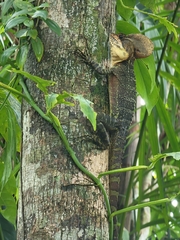
The western basilisk (Basiliscus galeritus), also known as the red-headed basilisk, is a large species of lizard in the family Corytophanidae. The species is endemic to northwestern South America. The specific name, galeritus, which is Latin, means "wearing a hood", referring to the head crest.

B. galeritus inhabits forests at altitudes of 0–1,600 m (0–5,249 ft) in western Colombia and western Ecuador in South America. Earlier reports of its occurrence in Central America are mistaken and actually refer to young of the closely related common basilisk.

Males of B. galeritus reach a total length (including tail) up to about 77.5 cm (30.5 in), while females reach about 63.5 cm (25.0 in). Its body color is olive-green with a reddish-brown underbelly. The throat is white to yellow. On the back it has a small crest similar to that of young individuals of the common basilisk. It may have a narrow white stripe or a row of white dots on each side. It has no back flap. The adult males bear a round head flap/crest.

The western basilisk has been introduced to Gorgona Island, Colombia. This species is not... Wikipedia →

Global Distribution

Parks Where Found

# Park Country Daily sighting probability
1 Utría National Natural Park 🇨🇴 Colombia
~60%

More parks will be added in future updates.

Zoos & Centres Where Found

# Zoo / Centre Country
1 Dallas World Aquarium 🇺🇸 United States In captivity

Before you go

What are the chances of seeing a Western Basilisk in Utría National Natural Park?

Likely

About 60% of wildlife watchers report a Western Basilisk sighting in Utría National Natural Park on a given day, based on 17 verified sightings from GBIF citizen-science data from 2019 to 2026. Over three days the chance rises to about 90%, and over a week to over 90%, if each day is a fresh chance.

When is the best time to see a Western Basilisk in Utría National Natural Park?

February

In that month about 80% of wildlife watchers report a Western Basilisk in Utría National Natural Park on a given day, against about 20% in March, June and December, the lowest months. That is one of Utría National Natural Park's driest months, with about 270 mm of rain against 710 mm in October. May has too few records to rate.

What time of day is best to see a Western Basilisk?

Between 1 and 4 pm

Across all the parks we cover, that three-hour window holds the most Western Basilisk sightings with a recorded time, and about 7 in 10 of them come between 6 am and 6 pm: it is seen both by day and at night.

Where else can you see a Western Basilisk?

Only Utría National Natural Park, in our data

Utría National Natural Park is the only park on Wallace's Line with enough records to rate Western Basilisk sightings: about 60% of wildlife watchers there report one on a given day.

Where does the Western Basilisk sighting chance come from?

GBIF citizen-science records

It is estimated from how often the Western Basilisk is recorded against all the reptiles logged in Utría National Natural Park (17 verified sightings from 2019 to 2026), calibrated against known sighting rates. Figures are rounded to the nearest 10% because citizen-science data supports honest approximations, not decimals, and months with records from fewer than five people show "—". How it works.

← Back to Utría National Natural Park