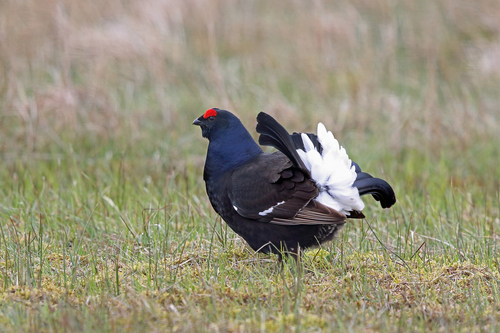
Eurasian Black Grouse

Eurasian Black Grouse

Lyrurus tetrix

Silhouette: Sheatherius · PhyloPic

LCLeast ConcernNTVUENCR
Daily sighting probability ~10% · With luck
at Vanoise National Park

In 3 days ~20% in a week ~40%

15 Verified sightings at Vanoise National Park From 2019 to 2026
45 In all 3 parks
October Best month
☀️ Diurnal When it's spotted

About the Eurasian Black Grouse

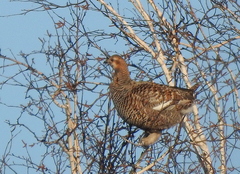
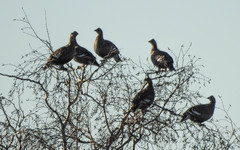
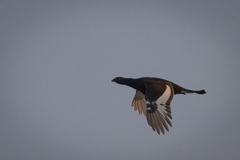
The black grouse (Lyrurus tetrix), also known as northern black grouse, Eurasian black grouse, blackgame or blackcock, is a large bird in the grouse tribe. It is a sedentary species, spanning across the Palearctic in moorland and steppe habitat when breeding, often near wooded areas. They will spend the winter perched in dense forests, feeding almost exclusively on the needles of conifers. The black grouse is one of two species of grouse in the genus Lyrurus, the other being the lesser-known Caucasian grouse.

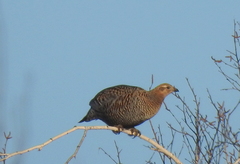
The female is greyish-brown and has a cackling or warbling call. She takes all responsibility for nesting and caring for the chicks, as typical with most galliforms. The black grouse's genome was sequenced in 2014. The black grouse was formally described by the Swedish naturalist Carl Linnaeus in 1758 in the tenth edition of his Systema Naturae under the binomial name Tetrao tetrix. Both Tetrao and tetrix come from Ancient Greek words referring to some form of game bird. The black grouse is now placed in the genus Lyrurus that was introduced in 1832 by the English naturalist William Swainson.

The male and female are sometimes referred to by their folk... Wikipedia →
Sounds

Song1:17

Sweden · 2025

© Lars Edenius · XC1006576 · CC BY-NC-SA 4.0

Call0:44

France · 2022

© Stanislas Wroza · XC730521 · CC BY-NC-SA 4.0

Flight call0:15

United Kingdom · 2016

© Simon Elliott · XC591855 · CC BY-NC-ND 4.0

Global Distribution

Parks Where Found

# Park Country Daily sighting probability
1 Cairngorms National Park 🇬🇧 United Kingdom
~20%
2 Hohe Tauern National Park 🇦🇹 Austria
~10%
3 Vanoise National Park 🇫🇷 France
~10%

Zoos & Centres Where Found

# Zoo / Centre Country
1 Novosibirsk Zoo 🇷🇺 Russia In captivity
2 wildlife park Feldkirch 🇦🇹 Austria In captivity
3 Plock Zoo 🇵🇱 Poland In captivity
4 Alpenzoo Innsbruck 🇦🇹 Austria In captivity
5 akwarium warszawskiego ZOO 🇵🇱 Poland In captivity
6 hipopotamiarnia i akwarium morskie warszawskiego ZOO 🇵🇱 Poland In captivity

Before you go

What are the chances of seeing a Eurasian Black Grouse in Vanoise National Park?

With luck

About 10% of wildlife watchers report a Eurasian Black Grouse sighting in Vanoise National Park on a given day, based on 15 verified sightings from GBIF citizen-science data from 2019 to 2026. It is the 67th most-seen of the 81 birds we can rate there. Over three days the chance rises to about 20%, and over a week to about 40%, if each day is a fresh chance.

When is the best time to see a Eurasian Black Grouse in Vanoise National Park?

October

In that month about 30% of wildlife watchers report a Eurasian Black Grouse in Vanoise National Park on a given day, against under 5% in January–March and June–September, the lowest months. November has too few records to rate.

What time of day is best to see a Eurasian Black Grouse?

Between 10 am and 1 pm

Across all the parks we cover, that three-hour window holds the most Eurasian Black Grouse sightings with a recorded time, and about 8 in 10 of them come between 6 am and 6 pm: it is a daytime animal.

Is Vanoise National Park the best place to see a Eurasian Black Grouse?

3rd of 3

Of the 3 parks where we can rate Eurasian Black Grouse sightings, Vanoise National Park ranks 3rd at about 10%. The best odds are in Cairngorms National Park (United Kingdom, about 20%) and Hohe Tauern National Park (Austria, about 10%).

Where does the Eurasian Black Grouse sighting chance come from?

GBIF citizen-science records

It is estimated from how often the Eurasian Black Grouse is recorded against all the birds logged in Vanoise National Park (15 verified sightings from 2019 to 2026), calibrated against known sighting rates. Figures are rounded to the nearest 10% because citizen-science data supports honest approximations, not decimals, and months with records from fewer than five people show "—". How it works.

← Back to Vanoise National Park