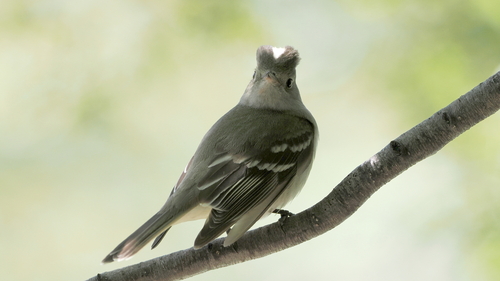
Chilean Mockingbird

Chilean Mockingbird

Mimus thenca

Silhouette: Edwin Price · PhyloPic

LCLeast ConcernNTVUENCR
Daily sighting probability ~10% · With luck
at Vicente Pérez Rosales National Park

In 3 days ~20% in a week ~40%

33 Verified sightings at Vicente Pérez Rosales National Park From 2019 to 2026
33 In 1 park
August Best month
☀️ Diurnal When it's spotted

About the Chilean Mockingbird

The Chilean mockingbird (Mimus thenca), locally known as tenca, is a species of bird in the family Mimidae. It primarily inhabits Chile's northern half, though there are sightings in Argentina. The Chilean mockingbird is monotypic.

The Chilean mockingbird is 28 to 29 cm (11.0 to 11.4 in) long and weighs 66 g (2.3 oz). The male is somewhat larger than the female. Adults have a wide whitish supercilium. Their crown, neck, and back are brownish gray with darker streaks and their rump browner. The wings and tail are blackish. The wings show two narrow bars when folded. The outermost tail feathers have white edges and most of the others have white tips. The throat is whitish, the chest brownish gray, the belly dirty white, and the flanks buffy with blackish streaks. The juvenile is similar but more buffy below with more streaks.

The Chilean mockingbird is found in Chile from Copiapó Province in the Atacama Region south to Los Lagos, Puerto Montt, and Chiloé Island. A small population also exists in Neuquén Province, Argentina. The Chilean mockingbird inhabits a wide variety of biomes, most of which are characterized... Wikipedia →

Sounds

Song0:36

Chile · 2021

© Cristian Pinto Fernandez · XC671180 · CC BY-NC-SA 4.0

Call0:31

Chile · 2015

© Cristian Pinto · XC386602 · CC BY-NC-SA 4.0

Song1:04

Chile · 1969

© Guillermo Egli · XC53876 · CC BY-NC-ND 2.5

Global Distribution

Parks Where Found

# Park Country Daily sighting probability
1 Vicente Pérez Rosales National Park 🇨🇱 Chile
~10%

More parks will be added in future updates.

Cities Where Found

# City Country Daily sighting probability
1 Santiago 🇨🇱 Chile
~40%

Before you go

What are the chances of seeing a Chilean Mockingbird in Vicente Pérez Rosales National Park?

With luck

About 10% of wildlife watchers report a Chilean Mockingbird sighting in Vicente Pérez Rosales National Park on a given day, based on 33 verified sightings from GBIF citizen-science data from 2019 to 2026. It is the 48th most-seen of the 70 birds we can rate there. Over three days the chance rises to about 20%, and over a week to about 40%, if each day is a fresh chance.

When is the best time to see a Chilean Mockingbird in Vicente Pérez Rosales National Park?

July and August

In those months about 20% of wildlife watchers report a Chilean Mockingbird in Vicente Pérez Rosales National Park on a given day, against under 5% in December to February, the lowest months. Those are among Vicente Pérez Rosales National Park's wettest months, with about 410 mm of rain a month against 85 mm in February.

What time of day is best to see a Chilean Mockingbird?

Between 2 and 5 pm

Across all the parks we cover, that three-hour window holds the most Chilean Mockingbird sightings with a recorded time, and about 9 in 10 of them come between 6 am and 6 pm: it is a daytime animal.

Where else can you see a Chilean Mockingbird?

Only Vicente Pérez Rosales National Park, in our data

Vicente Pérez Rosales National Park is the only park on Wallace's Line with enough records to rate Chilean Mockingbird sightings: about 10% of wildlife watchers there report one on a given day.

Which relatives of the Chilean Mockingbird live in Vicente Pérez Rosales National Park?

Same order: Passeriformes

The closest relatives of the Chilean Mockingbird that you can see in Vicente Pérez Rosales National Park (order Passeriformes, Perching Birds) are Austral Thrush (about 70%), Chucao Tapaculo (about 70%) and Thorn-tailed Rayadito (about 70%), with each one's daily chance of a sighting.

Where does the Chilean Mockingbird sighting chance come from?

GBIF citizen-science records

It is estimated from how often the Chilean Mockingbird is recorded against all the birds logged in Vicente Pérez Rosales National Park (33 verified sightings from 2019 to 2026), calibrated against known sighting rates. Figures are rounded to the nearest 10% because citizen-science data supports honest approximations, not decimals, and months with records from fewer than five people show "—". How it works.

← Back to Vicente Pérez Rosales National Park