About the Darwin's Frog
Darwin's frog (Rhinoderma darwinii), also called the Southern Darwin's frog, is a species of frog of the family Rhinodermatidae. It was discovered by Charles Darwin during his voyage on HMS Beagle on a trip to Chile. In 1841, French zoologist André Marie Constant Duméril and his assistant Gabriel Bibron described and named Darwin's frog. The diet of R. darwinii consists mostly of herbivore invertebrates. R. darwinii is currently classified as an endangered species by the International Union for Conservation of Nature.
Darwin's frog has an unusual method of brooding, in which the male will facilitate development of its tadpoles inside its vocal sac. This male brooding may make R. darwinii unique among extant frog species, as the only other frog that has this behavior is the R. rufum (northern Darwin's frog), which has been presumed extinct since 1981.
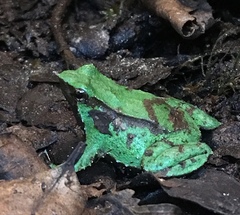
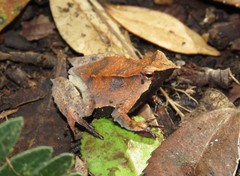
Darwin's frog is a small species with a snout–to–vent length of 2.2 to 3.1 cm (0.9 to 1.2 in). The snout is elongated into a fleshy proboscis which gives the head a triangular shape. The limbs are relatively long and slender. The front feet are not webbed, but some of the toes on the back feet usually are... Wikipedia →